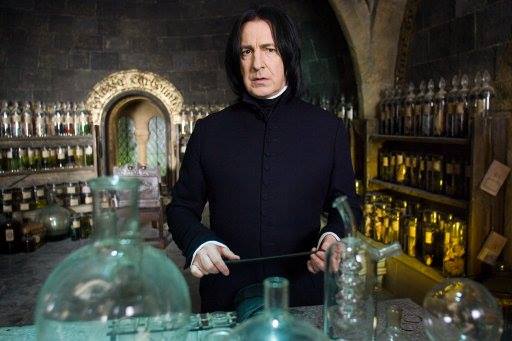
 Your news feeds are full of Alan Rickman—pictures, quotes, and tributes. Perhaps you’re tired of it, which considering the volume of posts would be understandable, but allow me to explain what it means in my point of view.
The Rickman post I’ve seen going around most is this:
“Actors are agents of change. A film, a piece of theater, a piece of music, or a book can make a difference. It can change the world.”
He’s right.
A lot of people aren’t missing him as the actor Alan Rickman. Many of my friends are mourning the loss of Professor Severus Snape, who despite being a fictional character—and not one people liked all the time—played a huge role in our childhood dreams.
As a storyteller, an ‘agent of change,’ I’m sure he knew this would happen. He must have been familiar with the sensation of attachment to a fictional character, one who to so many people was real.
This does not only apply to Harry Potter.
I’ve always been fascinated by the effect a good story has on an audience. Not everyone understands why we attach to fictional characters, more so than the actors who play them. I’ll admit I don’t follow the actors in movies, but love and respect what they represent. They become faces that get us through difficult times; we look forward to seeing them at movie premieres.
A film, a piece of theater, a piece of music, or a book can make a difference. It can change the world. No one understands this better than fandoms, communities who gather because they love the same stories. We stick together because we have a special magic in common, not just the magic found in Harry Potter!
Members of fandoms are familiar with the looks we get when we gush over a favorite movie or cry over the character’s death. We are strange to the rest of the world who consider fiction a waste of time—and we don’t care what they think, because fandoms are huge families.
Judgment from ‘normal people’ can’t budge us. It makes us stronger, steeling our bond, enforcing our love for something fictional.
If you ask me, there’s nothing fictional about the love we feel for these dreams, the stories told, and the actors behind them—even when we don’t recognize them by name.
I didn’t think much when I heard Alan Rickman had died. It wasn’t until they played a clip of him as Professor Snape that I became sad—because he was, and is, Professor Snape. I felt like I’d gone personally to Hogwarts and one of my teachers passed away.
Many will find this sentiment silly, but more yet will agree. This is the power of storytelling, fandoms, dreaming.
Alan Rickman’s death inspired this blog post, but I didn’t follow him as Alan Rickman. I followed him as Professor Snape, the favorite teacher to many. I never followed him as an actor, but he was part of my life and those of many other Potterheads.
So tell me fiction isn’t real. Tell me the sadness so many now feel is fake, an irrelevant waste of time. I disagree! Fiction might not be tangible, but it’s made so many people whole, creating beautiful friendships and unforgettable moments.
RIP, Alan Rickman, and thank you for giving us Professor Snape.










 Mariella Hunt
Leave a comment