
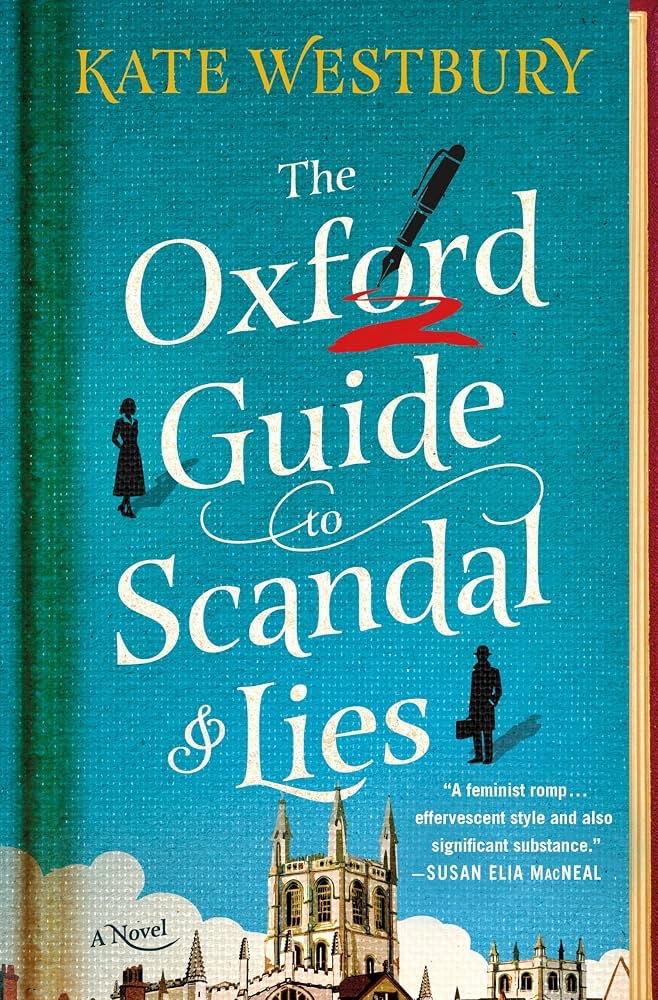
Set in Oxford in 1951, The Oxford Guide to Scandal and Lies brings together a university still living in the shadow of the Second World War, a young woman determined to make her own way, and a mystery that threatens to pull old secrets into the light. Ginevra Bishop is confident, clever, and perhaps a little too willing to trust her instincts, while Sidney Braithwaite carries wounds from the war that are less easily left behind. Against the colleges, traditions, friendships, and quiet intrigues of postwar Oxford, the two find themselves drawn into a story where scandal and loyalty can be difficult to separate.
I was delighted to speak with Kate Westbury about the making of the novel, the women who pursued higher education in this period, the complicated aftermath of war, and why community matters so much to Ginevra’s story.
Oxford feels almost like another character in The Oxford Guide to Scandal and Lies. What drew you to setting this mystery at the university in 1951?
I have always been enchanted with Oxford, partly because the tutorial system is such a distinctive approach to higher education that has vanished apart from a handful of schools. The architecture of the individual colleges, the university’s integration into the city–the history of both the university and the city—it all combines into a rich, fascinating setting for story atmosphere, one you can really sink your teeth into as both an author and reader. I settled on early 1951 because it felt far enough from the end of the war that characters’ lives have had enough years to resettle into normal grooves, but it’s also right before some interesting things happened on the espionage front. (If you’ve never heard of the Cambridge Five, that’s an important bit of Cold War history which will have ramifications inside my story too.)
Ginevra Bishop is a fascinating heroine because she is both intelligent and socially confident. What inspired her character, and what did you hope readers would understand about the experiences of women at Oxford during this period?
I always balk when people ask what inspired Ginevra and Sidney because their voices were so loud and clear from the very beginning. There was no character worksheet: Gin appeared with a story to tell, and I listened. That being said, Anne Shirley, Jo March, and Elizabeth Bennet were some of my dearest heroes growing up, and I can see glimmers of that same bright independence in Gin’s character. As I got to know her over the course of the first draft, what interested me most was how confidence can mask all kinds of wounds—loneliness, in Ginevra’s case–but she also has the resilience to not jump into the easy marriage that society expects her to make that would (ostensibly) make her life easier. In a world that often undervalued women’s capabilities, Gin bets on herself, and you see that same doggedness in the women who pursued higher education during this eraof postwar change.
Sidney Braithwaite carries the emotional scars of war throughout the novel. How did you approach writing about the lasting impact of the war on those who lived through it, even years after the fighting had ended?
I wanted to be very careful with how I portrayed his PTSD, that it wasn’t reduced to a stereotype and convenient plot point. I spent a lot of time thinking about how his mental health before the war contributed to where he is now and the myriad of different emotions someone who overthinks everything can be plagued by: the burden of rejecting parental expectations, the delight of finding something you love doing that ends up betraying you, the struggle to prove yourself when people expect—or want—you to fail. What Sidney experienced during the war left its scars, but the layers of what he’s still struggling to process are more complicated than a label, too.
It occurred to me recently that we’re about as far from the height of Covid shutdown as my characters would have been from the end of the war. When one considers the lingering repercussions of the former (and the enormity of the war in comparison), I think that offers some perspective to contemporary readers on how these characters would have felt about living in the shadow of WWII.
Gin has a strong support system and meaningful friendships, which is refreshing in a genre where heroines are often portrayed as isolated. Why was it important for you to give her these connections?
Community is historically foundational to Oxford college life, so this felt like a very natural, importantpart of the story. For someone like Gin–someone who has been starved for connection since her mother’s death–it would have been a breath of fresh air. When she’s eager to be real partners with Sidney too, his rejection stings all the more because of it. (As Sidney’s arc includes reckoning with no man is an island, Gin’s little found family plays a role in that, too.)
It was also important to me that her friends feel like fully realized characters who could carry their own story; they are not props in Ginevra’s life, and her relationship with them exists outside of the romance (much as they still might tease her). I want readers to enjoy those scenes (almost) as much as Gin and Sidney’s.
What do you hope readers take away from Gin’s journey, particularly her experiences with family, identity, and choosing the people who truly support her?
Gin is so extroverted and oriented toward the people around her that her journey is about realizing when it’s ok to let go of people—and things—that are hurting her. While she tends to be impulsive and acts on instinct—e.g. it’s easy for her to reject a marriage proposal at the start of the story (or to ignore Sidney when he brushes her off) because there’s no established bond—she’s also very loyal. Those deeper emotional splinters are harder for her to root out because she’s grown accustomed to the pain, and in this story, she must reckon with the boundaries of who and what deserves her loyalty.
Which three books would you recommend to Tearoom readers right now, and why?
The Eights by Joanna Miller is a fictionalized account of the first matriculating class of women from Oxford in 1920. If you’re craving more historic Oxford with a good mix of comedy and pathos, this one is exquisite.
The Cloak and Dagger Club by Jackie McMahon –This is a 1930s mystery inspired by the real-life Detection Club, and Jackie is an impressive student of the era. She really captures the style of Golden Age mysteries, creating a very clever, Christie-esquepuzzle with a side of second-chance romance. There is a sequel coming next year, too!
I am also recently obsessed with The Unselected Journals of Emma M. Lion series by Beth Brower. Beautifully written, deep character work, hilarious; I pitch them to my friends as L.M. Montgomery x P.G. Wodehouse x Gilmore Girls. I don’t remember the last time I wanted to escape somewhere as badly as I want to live in St. Crispian’s.
Thank you to Kate Westbury for joining me at The Tearoom and for sharing such thoughtful insights into Ginevra, Sidney, and the world of postwar Oxford. The Oxford Guide to Scandal and Lies is a story about secrets, friendship, resilience, and the difficult question of where our loyalties belong—and I’m delighted to have had the chance to talk with Kate about the world she created.
The Oxford Guide to Scandal and Lies releases September 1, 2026. If you’re drawn to historical mysteries, postwar Oxford, and characters who refuse to be neatly defined by the world around them, keep this one on your reading list.


Leave a Reply