
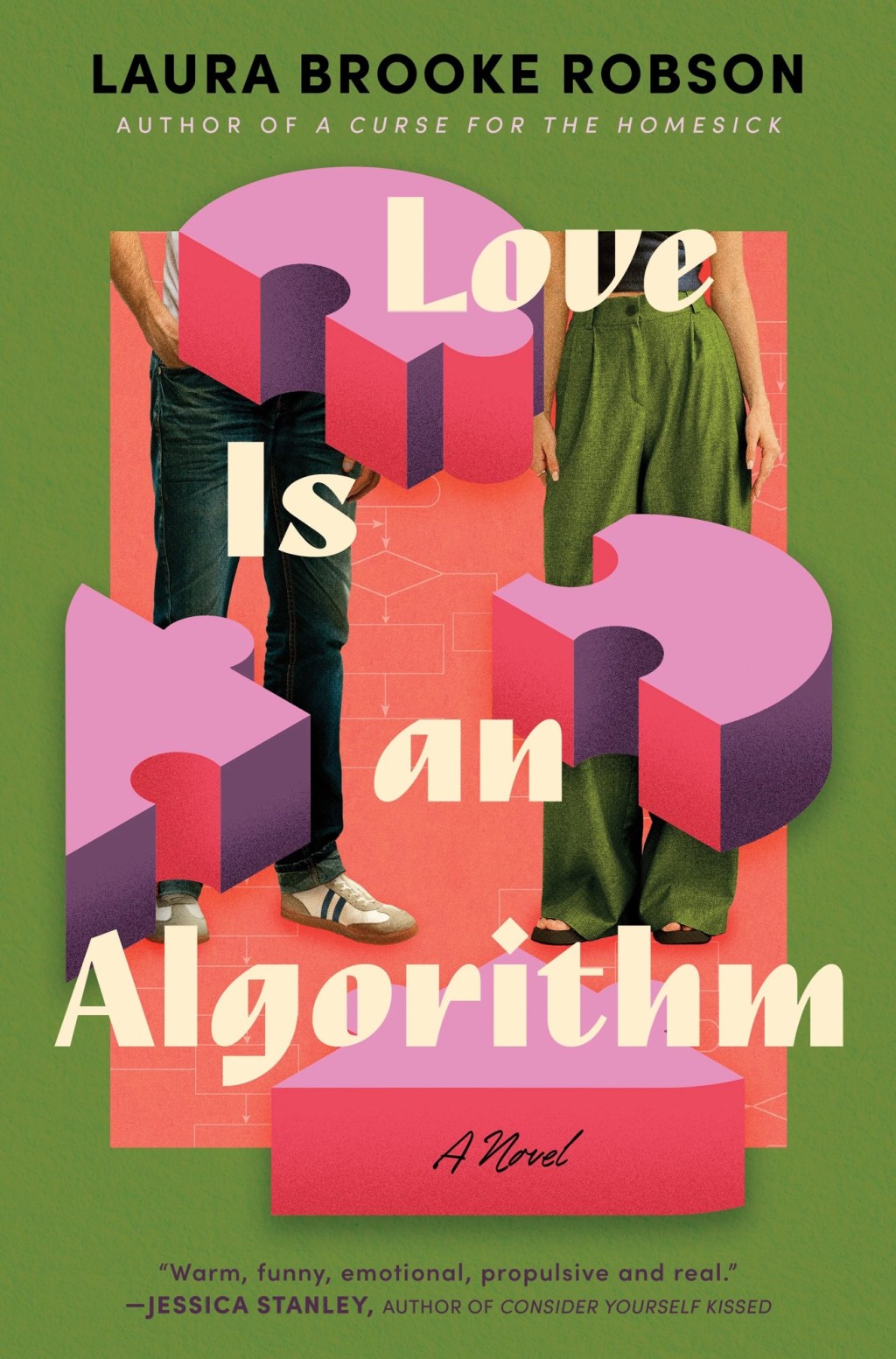
Books are not only meant to be entertainment. While we all love novels that distract us from the realities of life for a time, they have a role that’s just as important: even the most amusing novel, the most entrancing bit of escapism, often teaches us lessons or shows us truth between its pages.
When author Laura Brooke Robson reached out to me about her novel, Love is an Algorithm, I was intrigued, not least by the title. I had come to think of “algorithm” as an ominous word, so I was curious to see how a book could take the concept and turn it into a story about love.
Robson’s novel is quite far from my comfort zone, but I was delighted by how it addressed so many of the issues we’re dealing with right now. Is AI a danger to us? Does using AI constitute a moral fault? Can we ever achieve a balance? I address these questions in my review, which I will post shortly.
For now, I asked Laura some questions about her novel and the subjects it explores. I hope you enjoy the interview!
Q: Was there a particular human difficulty—awkwardness, uncertainty, rejection, loneliness, making a mistake—that became central to the novel for you?
A: Everything you said—but uncertainty most of all! All through my teens and twenties, I was fixated on this question of “How do you know you’re in a good relationship?” I felt extremely uncomfortable tolerating this uncertainty. In retrospect, tolerating uncertainty is basically just what confidence is, and I’m glad I had to learn it. And when I think of what freaks me out about AI, I think of people not getting the chance to tolerate uncertainty.
Q: The title suggests that love might be something an algorithm can understand or even reproduce. What, to you, is the part of love that cannot be calculated?
A: Can I tell you a secret? This was the publisher’s title, not mine. My title was Fox Pass, which makes sense when you read the book.
I do believe there must be some aspects of love that could be calculated. With enough brain electrodes, I feel like you could put together some great data. But I think most of what we’d consider a “love algorithm” would be understood retroactively, not predictively. That’s something I try to get at in the book. If someone told you your relationship was a 100/100, or a 12/100, you would behave differently. You would write—or rewrite—your love story based on the information. So I think that’s what we can’t calculate—how we respond to the story as we’re living it.
Q: So many of the human relationships in Love Is an Algorithm are difficult, particularly within families. At the same time, the technology in the novel offers forms of connection that can feel easier and more immediately satisfying. Were you interested in exploring whether the very difficulty of human relationships—the misunderstanding, disappointment, and need to keep choosing one another—is actually part of what makes them rewarding?
A: This is it exactly. So often, you hear people defend technology as a way to make people feel connected when real people aren’t available. AI companion chatbots, or using social media rather than socializing. There are edge cases where this might genuinely make someone feel less alone, but on the whole, I think these tech alternatives to real human relationships A) take up the time we’d otherwise use for humans and B) atrophy our ability to ask meaningful questions and offer vulnerable answers.
Q: Do you think AI changes the way we understand our own intelligence, or does it mostly reveal things we already wanted to believe about ourselves?
A: What a fabulous question. Can I say it does both? We all know LLMs are sycophantic yes men, telling us we’re right, valid, superior—all the things we’d like to believe about ourselves that a true friend might gently help us keep within reason. But I also think AI diminishes our sense of intelligence and capability. There was a New York Times article from last week that used the phrase “cognitive surrender,” and I can’t stop thinking about it. Dependence on AI leads to cognitive surrender—refusing to begin formulating an answer before you have even fully comprehended the question. I think it makes us subconsciously believe we are intellectually helpless.
Q: Your characters interact with technology in very human ways. Did you find yourself becoming more interested in the technology itself, or in what people reveal about themselves when they use it?
A: I’m always most excited by the people using the technology. My first few novels were fantasy, and I think I treat fantastical conceits and technology the same way in my writing—it’s really just a vehicle to talk about human behavior.
Q: The cyberbullying portrayed in Love Is an Algorithm is disturbing yet painfully believable. The “mob” of people who attack Eve represents a different kind of online threat than the increasingly common problem of AI-generated “slop”: it is human hostility, amplified and organized by technology. What drew you to explore that particular kind of online mob behavior, and what did you hope readers would understand about it?
A: I worried readers might find this piece of the book outlandish or unbelievable, because it is kind of unbelievable—it’s just also happening in real life. To me, so much of this book is trying to answer the question, “How do we know what’s real?” How do we know our love is real? How do we know the story we tell ourselves about our family is real? How do we know the thing my phone is showing me is real? And I think it also gets at this experience of the internet a lot of us have had, which is—how do we continue to understand the humanity of others when they are reduced to online avatars?
Q: What did you want readers to feel when they reached the end of the novel—not necessarily what did you want them to think?
A: I wanted readers to feel a little bit less lonely. Like maybe they were in the mood to go meet a friend for coffee.
Q: How can we support human authors and artists in a rapidly changing world, particularly as AI becomes increasingly capable of producing writing and art?
A: Celebrate community around art! This is such a big, thematic part of this book, and the irony is, I was not doing a good job of it myself until after the book came out. This was the year I looked around—at all the changes in AI, all the dire data about literacy across the country—and thought, “Why am I not in ten book clubs? Why am I not starting my own book club? Why am I not attending every single literary event and art gallery opening and concert I can find?” Reading a book in isolation is great, but finding a friend to read with is the best.
Q: And finally, which three books would you recommend to us right now?
A: I’m going to go very eclectic here:
- Out There by Kate Folk. A collection of short stories that are all pretty out there. I found Kate Folk via her New Yorker story of the same name, and it just keeps getting more relevant. Think: going on dates with robots and trying to figure out whether they’re human based on how careless they are with your feelings.
- Dopamine Kids by NPR science writer Michaeleen Doucleff. This is a nonfiction parenting book. I do not have kids, nor am I pregnant. But it taught me so much about how technology affects my brain and how to set myself up to regain control over my attention.
- Playworld by Adam Ross. Brutal and wonderfully written. Set on the Upper West Side—a great read for anyone who loves New York.


Leave a Reply