
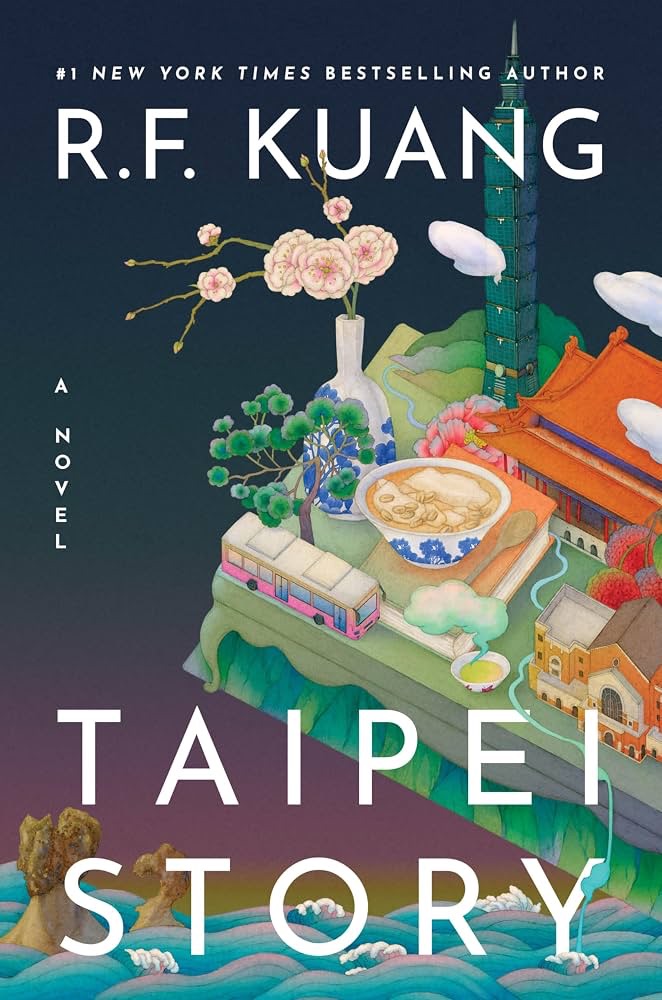
Learning a new language is often described as opening the door to another world. But what happens when that language is also part of your own heritage?
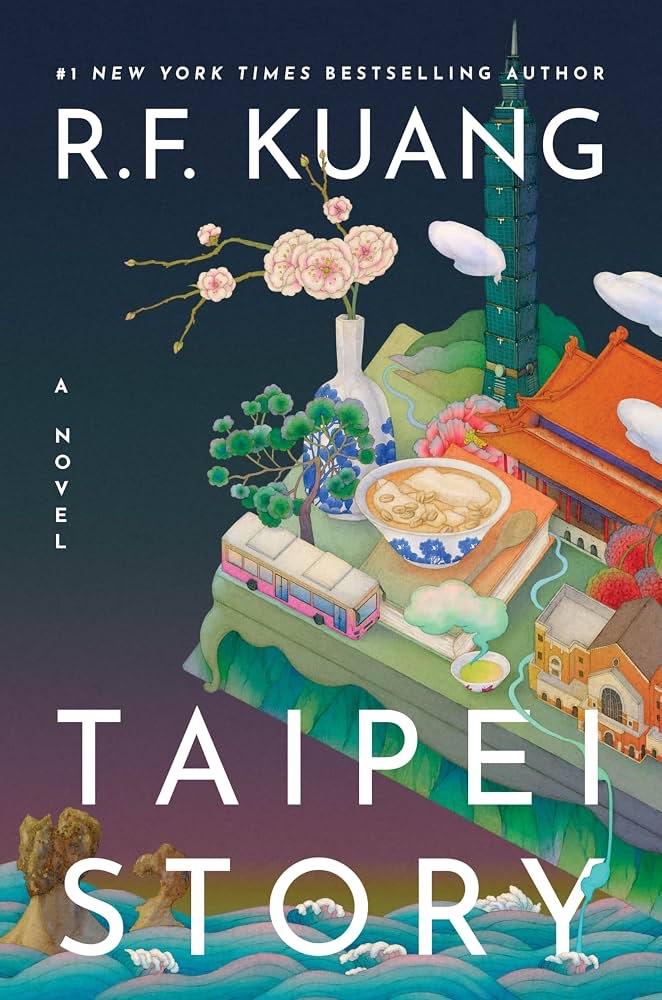
That is the question at the heart of R.F. Kuang’s Taipei Story. While many readers know Kuang for her sweeping historical fantasy and literary fiction, this quieter novel turns its attention inward. It is less concerned with epic events than with the complicated process of discovering who we are when our family history spans more than one culture.
College student Lily Chen travels to Taiwan with the goal of improving her Chinese. Like many language students, she imagines that immersion will quickly solve the problems that textbooks cannot. Instead, she discovers just how exhausting it is to live every day in a language she does not fully understand.
Simple tasks become difficult. Reading street signs gives her headaches. Ordering food requires concentration. Conversations move too quickly. Every mistake reminds her that she is an outsider, even in a place connected to her own family history.
Kuang captures this frustration remarkably well. Anyone who has studied another language—or moved somewhere unfamiliar—will recognize the constant mental effort that accompanies everyday life. There is a particular kind of loneliness that comes from understanding just enough to realize how much you still do not know.
Yet Taipei Story is about much more than language.
As Lily adjusts to life abroad, her relationships begin to unravel. A misunderstanding involving a mutual crush creates tension with her roommate, Anna, until their friendship nearly falls apart. Then tragedy strikes when Lily’s grandfather dies unexpectedly.
His death becomes one of the emotional centers of the novel.
Although Lily was never especially close to him, she had quietly imagined that learning Chinese would one day allow them to know one another better. Without fully realizing it, she had postponed those conversations, assuming there would always be more time.
There wasn’t.
The novel explores a painful truth that extends far beyond this particular family. Many of us postpone difficult conversations. We tell ourselves we’ll ask our grandparents about their childhoods next holiday, call an old friend next month, or finally pursue a dream after life becomes less busy.
Life rarely waits for us.
One of the strengths of Taipei Story is that it refuses to present cultural identity as something that can be mastered through effort alone. Lily often feels guilty for not speaking Chinese as naturally as someone who grew up surrounded by it. She worries that she has somehow failed her family or become disconnected from her roots.
But the novel gently challenges that fear.
Late in the story, Lily realizes that many Taiwanese students spend years learning English, experiencing the same frustrations she does while learning Chinese. They stumble over grammar, mispronounce words, and worry that they will never sound fluent.
The struggle belongs to everyone.
That realization transforms what initially seemed like a story about one woman’s heritage into something much more universal. Whether we are learning another language, beginning a new career, moving to another country, or simply trying to understand another person’s perspective, we all experience the awkwardness of being beginners.
The novel argues that this awkwardness is not evidence of failure. It is simply the cost of learning.
Reading Taipei Story also reminded me of another recent novel I enjoyed: Whale Fall by Elizabeth O’Connor.
Both books explore the barriers language can create, though from opposite directions. In Whale Fall, outsiders believe they understand another culture while distorting its stories to suit their own expectations. In Taipei Story, Lily fears she understands too little, placing impossible expectations on herself until she forgets why she wanted to learn in the first place.
Together, the novels suggest that genuine understanding requires humility. Neither certainty nor perfection brings us closer to another culture. Curiosity does.
One of the aspects I appreciated most was the novel’s patience. Rather than offering dramatic revelations about identity, Kuang allows Lily’s understanding to develop gradually through ordinary experiences. Walking unfamiliar streets, making mistakes, grieving a loved one, and repairing damaged friendships all become part of the education she could never have received in a classroom.
That quiet approach makes the novel feel deeply authentic.
Perhaps the greatest lesson Taipei Story offers is that identity is not something we solve once and for all. It continues to evolve throughout our lives.
Our family history shapes us, but so do our choices. We inherit languages, traditions, and memories, yet we also create new ones. Complete understanding—of a culture, another person, or even ourselves—may always remain just beyond reach.
That is not a failure.
It is simply part of being human.
If you enjoy thoughtful literary fiction that explores family, language, grief, and cultural identity with sensitivity and intelligence, Taipei Story is well worth reading. Rather than offering simple answers, it invites readers to embrace uncertainty, remain curious, and extend themselves the same patience they would offer anyone learning something new.
Sometimes the greatest journeys are not the ones that take us across the world, but the ones that help us understand where we came from—and who we are becoming.
If you enjoyed this essay, you might also like:
- The Girl and Her Books — how I became a reader at a very young age.
- The Literary Life of Marilyn Monroe — how Marilyn Monroe built a personal library that would surprise us.
- More book reviews from The Tearoom on Substack.


Leave a comment