
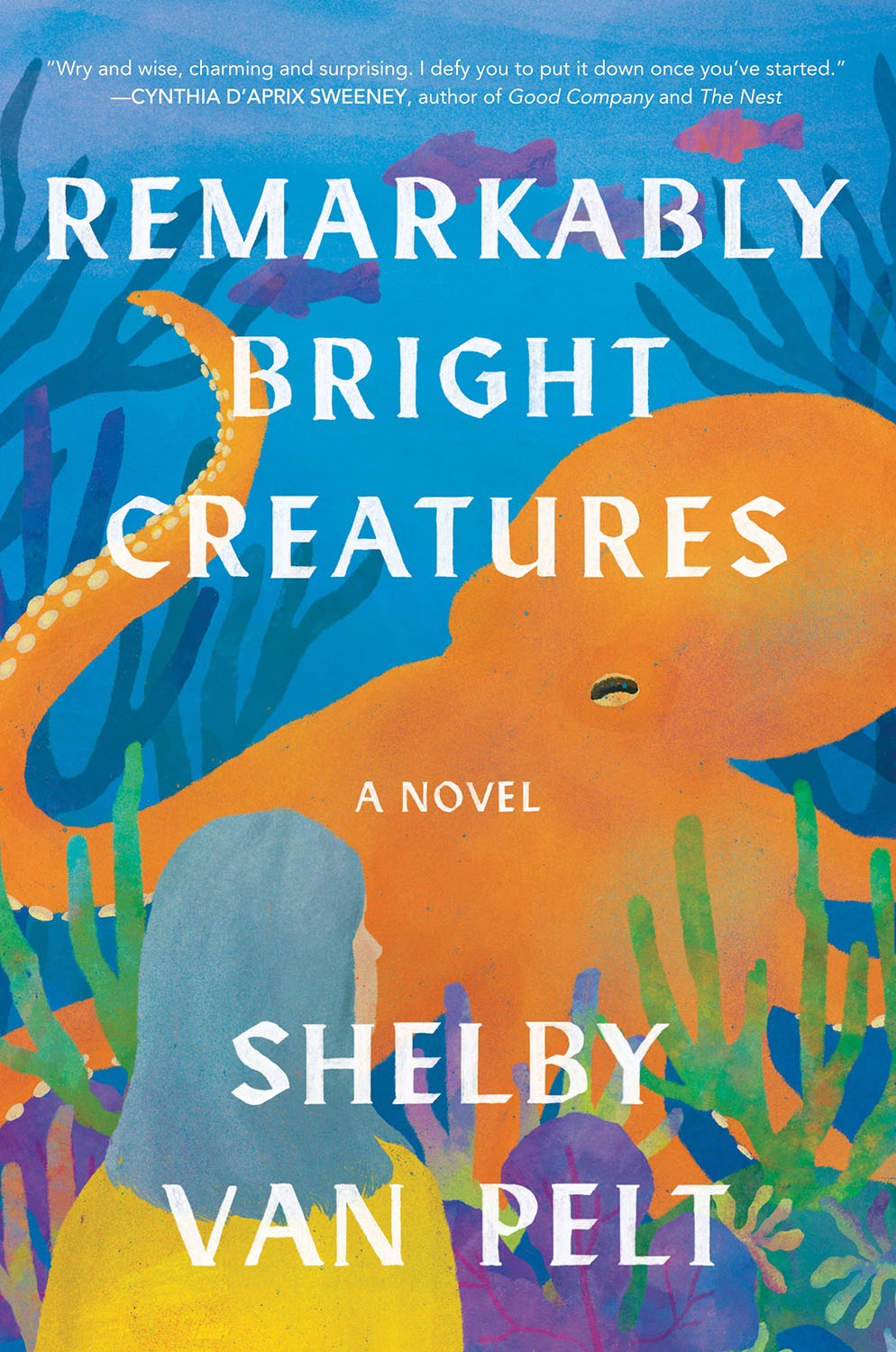
Some of the most charming novels are those that feature an animal as a protagonist, spinning their viewpoint of the world and the humans living in it. My first favorite book series was Warriors by Erin Hunter, in which a house cat runs off into the woods to join one of four clans of wild cats. It was a long series, one I intend to revisit one day.
Remarkably Bright Creatures does something even more unusual, as it features the viewpoint of an old octopus named Marcellus. He has been trapped in a tank at an aquarium for four years, and can feel that his life is nearing its end. The only human he has grown to like is Tova, the elderly cleaning lady who comes in at night and takes the time to greet all of the creatures in the aquarium when she arrives. Marcellus sees her kindness compared to other humans, and appreciates it.
Marcellus has grown understandably bored in his tank, so he begins to escape on nightly excursions to wander the aquarium. Tova realizes what is happening, but sympathizes with him — so much so that she prevents the aquarium’s owner from clamping the tank shut.
When the collapse of a stool gives Tova a sprained ankle, her doctor tells her that she needs to rest in order to recover. The aquarium hires a young man named Cameron to replace her during this time. Marcellus notices immediately that there is a biological link between the lonely old lady and Cameron — Cameron, it turns out, is looking for his biological father, having fallen on hard luck and finding himself in need of money. He gets the job at the aquarium, and ends up finding more true fulfillment there than he expected; success earned honestly is so much more memorable.
Knowing that his days are numbered, Marcellus makes a plan to reveal the connection between Tova and Cameron, as a gift to Tova for her kindness. But humans can be incredibly dense. The octopus knows it will be a challenge to make them both understand before his time runs out. He welcomes the challenge, and soon his nightly adventures have a purpose other than entertainment. Among the stunts he pulls is stealing Cameron’s license so that Tova can see his surname. Tova, for her part, must also learn to accept help from the people who care about her — we are not meant to live this life completely on our own.
Marcellus’ personal mission is charming because many people never stop to consider that animals can understand us. We make the mistake of believing that other species are unintelligent. While an animal in real life will not have the insight and understanding of Marcellus, it is a mistake to believe that they do not feel love, longing, grief, or excitement — a mistake to assume that they do not have souls.
The person who spends real time with animals soon realizes that we’re not so different. They also understand that this similarity is not a bad thing. We might have minds that work differently than a dog’s or a bird’s, but we still learn much about the world around us by observing them and their behaviors. There are things in this world far greater than us and our ambitions. A bird sees the world differently than we do, and can sing songs that we could never replicate. When we begin to understand the strength and wisdom of these creatures, we achieve a new sort of freedom — the closer we come to taking off in flight ourselves.
Tova’s bond with this octopus might have been fictional, but it is still possible to become best friends with another creature — be it a beloved pet or an animal we meet outside. We are on this planet to help one another through difficult times, and when friendship with an animal exists, it can be a source of joy beyond description. We need only be able to walk outside with open hearts.
Remarkably Bright Creatures is a tale of loss, found family, and powerful friendship. It is a comforting novel as well as a perfect summer read. Let it inspire us all to be open to connections with hearts in the wild as well as at home.
A Personal Reflection
We are healthier in many ways when we allow ourselves to connect with animals and nature — it is good for our mental health as well as our physical health. If it isn’t possible to go outside (in my case, for example, seasonal allergies sometimes prevent it), there are other ways to benefit from nature, such as drawing it, writing about it, and studying it. The world is so vast that I cannot understand how a person could not love it or take any interest in it.
Reading this novel reminded me of the memoir Grayson, which tells of its author’s adventure bonding with a baby gray whale one afternoon while out on a swim. Grayson and Remarkably Bright Creatures remind us that, with patience and a lot of love, different species can come to understand one another. Love is a language I consider to be universal. And with humility comes understanding and wisdom — a person cannot learn without first admitting that they do not know.
A person who can find meaning in a flower or a leaf has truly learned to see nature as a source of joy, of less stress, and of imagination. It is another way we remain healthy, and always have something to create. Nature has much to offer us. It can never be fully known, but it provides a quiet wealth worth spending a life pursuing.
Want more reviews like this one? Find them at The Tearoom on Substack.


Leave a comment