
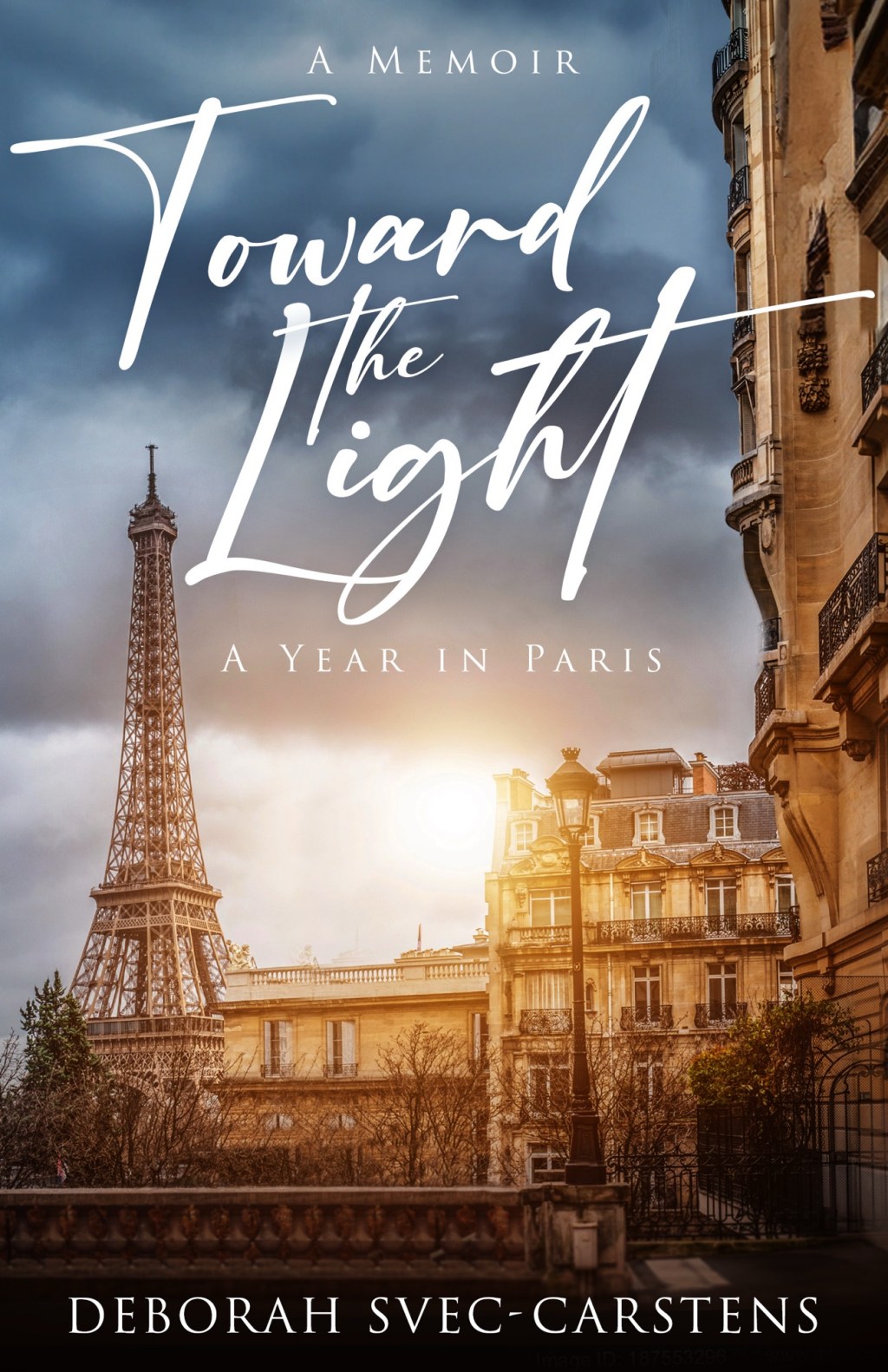
A Year in Paris, and the Story That Followed
In 1992, Deborah Svec-Carstens was a young French major living in small-town Iowa, uncertain about what she wanted to do next. She had never been to France. Then an au pair position gave her an opportunity to change that.
What followed was a year in Paris that would become far more complicated than she could have imagined—and, years later, the subject of a memoir.
Toward the Light: A Year in Paris is the result of ten years of writing, revising, and querying. But Deborah’s story is about more than a young woman finding her way in a foreign city. It is also about loneliness and friendship, trauma and resilience, the complicated experience of belonging somewhere while remaining an outsider, and the long process of finding the courage to tell a difficult story.
In our conversation, Deborah shares what life was actually like as an au pair in early-1990s Paris, why she chose to leave Iowa, how building a community helped her through an unexpectedly difficult year, and what it means to finally hold that experience in her hands as a finished book.
She also talks about the writers and memoirs that have stayed with her—and offers some quietly powerful advice for anyone trying to tell a story of their own.
Q: Prior to reading your memoir, I had only a vague sense of what being an au pair involved. Could you tell us a bit more about the experience?
A: I went through a placement agency to find an au pair position in Paris. I can’t speak to the au pair experience today, but when I worked as an au pair in the early 1990s, the job entailed childcare and light housekeeping. I received a small monthly salary, plus room and board.
Each afternoon, I picked up Lily, the six-year-old girl I cared for, from school and entertained her until dinner time. We went to a nearby park or returned to the apartment for a snack, cartoons, and play time. I helped cook dinner and ate with the family. When my duties were done for the day, I would retreat to my chambre de bonne, a small room on the top floor of the apartment building where the family lived, or go out with friends. I would usually babysit at least one evening a week, sometimes more.
French children don’t have school on Wednesdays. I spent the day with Lily and attended to my housekeeping duties, which included ironing, vacuuming, and dusting. Weekday mornings the rest of the week, I attended French language classes, first at the Sorbonne and later at Alliance Francaise.
One of the most challenging parts of the job for me was being part of the family and an outsider at the same time. A few scenes in Toward the Light: A Year in Paris (available September 15) describe the initial difficulties that arose because of that dynamic. My relationship with Lily and her parents changed over the course of the year, due in part to shifting family dynamics, but also because of the sexual assault I experienced two months after my arrival, following a morning run. When I left Paris, I took with me both a love for Lily and a deep gratitude for her mother.
Q: Tell us about your decision to leave home and spend time in France. What were the days and weeks leading up to your departure like?
A: After graduating from college in the spring of 1992, I returned home to live with my parents in small-town Iowa, uncertain of what career path I wanted to follow. I returned to an administrative job at the company where my dad worked and continued to apply for a variety of jobs that I thought might fit my interests and background. Rejection letters piled up, and I decided to apply for an au pair job in Paris.
I was a French major who had never been to France. An au pair position would provide the opportunity to live in Paris, improve my French, and make enough money to get by. I saw it as the only viable option for living abroad, and a chance to step back and think about the direction I wanted my career to take.
I left Iowa within weeks of accepting the position. Those weeks were filled with excitement and nervousness, as I shared the news with family and friends. Not until I was on the plane to Paris did the gravity of my decision finally hit. I would be living in a city, in a country, where I’d never been. I didn’t know anyone there.
I could never have predicted that my year in Paris would turn out to be one of the most challenging periods of my life.
Q: Do you think your experience would have been different if you had chosen to do this today?
A: My initial experience of loneliness would likely have been different because of the technology available today. When I lived in Paris, I had to use a payphone across the street from the apartment to call the US, which I did about once a week. Today, smartphones and the internet make staying connected much easier.
Instead, I had to build a community of friends in Paris. In the aftermath of trauma, that mattered more than it might have otherwise.
Q: What’s it like to have your experience in the form of a memoir?
A: After ten years of writing, revising, and querying, holding the finished book in my hands is both surreal and a dream come true. When I started writing Toward the Light: A Year in Paris, I wondered whether I might uncover another layer of healing.
Over time, my initial reason for writing expanded beyond myself. I wanted my family to know all of what I’d experienced. I wanted my nieces and nephews, most of whom are now young adults making their way in the world, to know I was courageousand resilient, and they could be, too. And I hoped the book would find a wider audience among survivors and their loved ones, offering them hope and healing.
Q: What advice would you give to someone who is considering taking a similar path?
A: My advice for other writers or for survivors who want to write their own story is twofold:
First, keep going. Take a break when necessary, but do your best to keep showing up to write, whether it’s for five minutes or five hours. Life will happen, but if you believe in the writing and your project, don’t give up on it. Don’t give up on your story. Don’t give up on yourself.
Second, find a community of writers. Writing is a solitary endeavor, but it requires support and encouragement from others. I’m fortunate to be part of a writing group that’s met for more than ten years. They were there to cheer me on when I wanted to quit.
Q: And finally, I would love to know about your favorite books! What are you reading these days, and are there any books that have stayed with you over the years?
A: There are several memoirs that have stayed with me, including:
• Wild by Cheryl Strayed
• Appetites by Caroline Knapp
• Know My Name by Chanel Miller
• The Desert Pilgrim by Mary Swander
• The Dance of the Dissident Daughter by Sue Monk Kidd
• Slip by Mallary Tenore Tarpley
I’m currently reading Skylark, a historical novel by Paula McLain. I recently read Courtney Maum’s memoir The Year of the Horses, and her new novel, Alan Opts Out. And I just finished The Names, a novel by Florence Knapp, which will probably make my top 10 list for this year.
I’m grateful to Deborah for being kind enough to send me an advance copy of Toward the Light. It was a pleasure to read her story and then have the opportunity to talk with her about the experiences behind it.
The memoir will be published on September 15, and I’m delighted to be able to share a little of her journey with you ahead of its release.
Preorder at https://deborahsveccarstens.com/toward-the-light/


Leave a Reply