
Literature often presents itself as a bizarre form of magic. An author can find herself writing a novel that, emotionally, is far from how she feels in real life. This was the case for L.M. Montgomery, author of Anne of Green Gables, for much of her life.
Montgomery created worlds of color. These worlds were saturated with the beauty of nature, populated by protagonists such as Anne Shirley, who were prone to dreamy epiphanies. She used words to paint worlds of light. Yet it came to be known, after her death, that she suffered from depression for much of the time she spent writing about Avonlea.
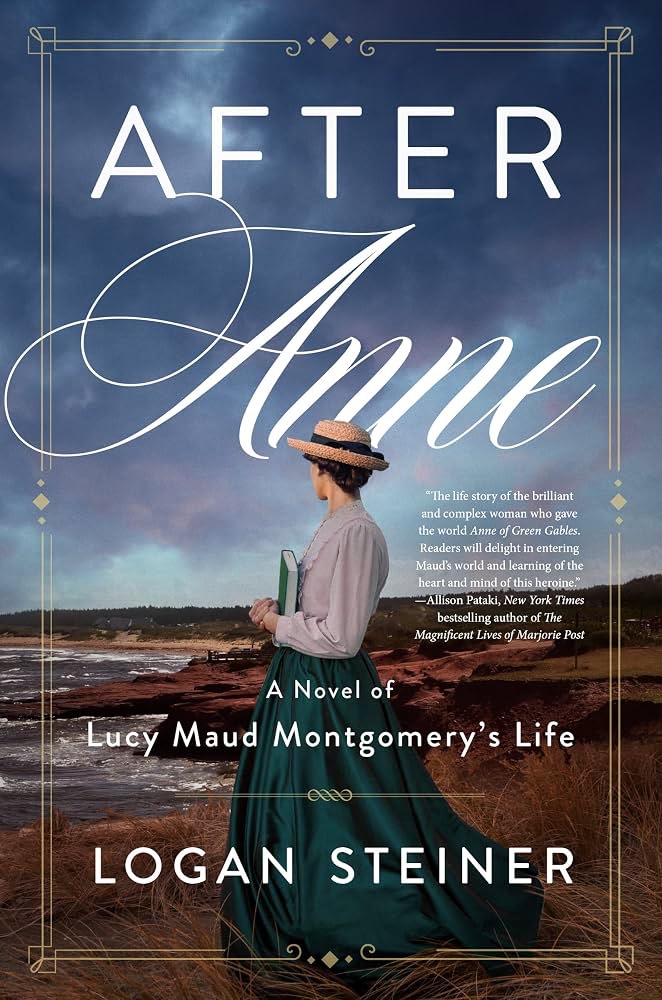
After Anne by Logan Steiner is one of my favorite novels. It centers on the life of L.M. “Maud” Montgomery before and after her marriage. We are delighted by scenes in which she “meets” and begins writing about Anne. We also witness Maud’s emotional transformation as she meets her future husband, Ewan MacGregor, and develops affection for him. We soon discover that affection is not enough to erase the questions she carries into their marriage.
I reached out to Logan Steiner and asked if she would answer some questions about After Anne in preparation for my review, which I will publish soon. To my delight, she agreed, and I had the privilege of discussing one of my favorite novels with its author.
Here’s the interview. If you haven’t yet read After Anne, I highly recommend you do so. Logan Steiner can be reached at Substack and her personal website.
Q: You write Maud as someone who recognizes very early that marriage could either deepen her life or diminish it. What drew you to that tension in Montgomery’s life, and how did you approach imagining what she might have been thinking and feeling as she considered marriage?
A: Yes, this tension! You’ve captured it well. Maud’s talent and fame set her apart, but her marriage decision is so relatable. We all wish we had perfect foresight on whether and whom to marry, so I hoped this focus would help readers connect. I found Maud’s premonitions around marrying Ewan fascinating—along with the possibility that she added some of those ideas while editing her journals in midlife, with the benefit of hindsight.
I based my portrayal of Maud’s conflicting thoughts about marriage largely on her own journals. I then imagined the birthday weekend as a time missing from her journals when that tension might have come to a head.
Q: Maud’s relationship with writing is almost a love story in itself. She knows that writing is the one thing she “could not bear to lose.” Did you see her literary ambition as something that competed with her desire for love, or did you see writing as the deeper love in her life?
A: I do think Maud had a deeper love story with writing than she did with Ewan. Writing was her refuge. When those stories competed, writing inevitably came out on top, to Ewan’s dismay. That is not to say that marriage and creativity need to compete. But Maud’s story shows how difficult a creative path can be when paired with an insecure partner.
Q: Ewan is not portrayed as an obviously cruel man. Instead, his insecurities, wounds, and beliefs gradually become more troubling. Why was it important to you to write a man whose danger is more complicated than simple villainy?
A: I rewrote the scenes with Ewan more than any others in the novel. Like many of us, he was limited but trying, and I was intent on rounding out his character. As much as I initially wanted a different relationship for Maud, I came to understand Ewan better as I reworked his scenes. I now see their marriage as a tragedy of circumstance rather than a tale of villainy.
Q: Maud’s cousin, Frede, challenges Ewan when he asks about her “womanly ambitions.” She asks him whether he would have asked the same questions if she were a man. What did you hope Frede would illuminate about the expectations placed on women in Maud’s world—and, perhaps, about the kind of friendship Maud needed?
A: Frede put plainly what I thought many readers would feel—that societal pressures on women can run counter to living a full life. Maud and Frede’s relationship reminded me of friends in my life whose honesty and openness puts me at ease. I love being around people who say the thing without worrying constantly how someone else will hear the thing. That was Frede to Maud.
Q: Maud’s fear of losing her writing reminded me of Sybil van Antwerp in The Correspondent, whose eyesight threatens her ability to read and write. Both women are confronted with the possibility of losing the thing that gives their lives meaning. Did you think of Maud’s relationship with writing as a kind of survival?
A: Yes. Mary Oliver says in her poem The Journey that she wrote “to save the only life [she] could save.” Writing, particularly journaling, is a life-saving force for me. That’s one way I immediately connected with Maud; I do think it was a matter of survival for her too. Like Sybil van Antwerp (one of my favorite characters of recent decades!), when Maud started to lose her connection to writing, she lost her center of gravity.
Q: There are moments when Maud seems almost instinctively wary of Ewan, even before she can articulate why. How much did you want the novel to explore the experience of a woman sensing something about another person that she cannot yet prove or explain?
A: I’ve recently come to realize just how much intuition has guided big decisions in my life, and I’m fascinated by the extent to which some part of us just knows. Maud’s journals show the conflict that can arise between intuition and reason. Despite her instincts, part of her wanted to simply marry the man who looked good on paper, as society expected. I sought to explore that conflict in the novel.
Q: Montgomery, Jane Austen, and Louisa May Alcott all wrote extensively about romance while creating lives centered on their own work. Did your research into Montgomery change the way you think about the relationship between the romantic heroines these women created and the women they were themselves?
A: My research deepened my respect for writers who create enduring love stories out of imagination rather than direct experience. It may be that unfulfilled desire creates more yearning and interest in describing the path to desire fulfilled.
Q: If you could ask L.M. Montgomery one question about the life she actually lived—not Anne’s life, not Maud’s imagined life, but her own—which question would you most want to ask her?
A: What do you understand now that you couldn’t have understood earlier?
Q: And, because this is The Tearoom: if L.M. Montgomery could join us at the table for an afternoon, which books would you want to put beside her teacup, and why?
A: I’d love that tea. I’d be most curious about her relationship with her own work, so I’d put The Story Girl beside her (her favorite of her novels), along with a journal or two. And The Complete Poems of Emily Dickinson, so we could share favorite lines.
A Final Word
Reading After Anne made me think about the strange distance that can exist between the worlds a writer creates and the life she is actually living. Montgomery gave generations of readers a world filled with beauty, friendship, imagination, and hope, even while carrying private struggles that those readers could not see.
Logan Steiner’s novel invites us to look beyond Anne and toward the woman who created her—to consider Maud not simply as the author of beloved books, but as a woman trying to make a life in which writing, love, friendship, and independence could coexist.
I’m especially grateful to Logan for joining me at the Tearoom table to talk about these questions. Her answers only deepened my affection for After Anne, and for Maud herself.
And perhaps that is one of the gifts of literary historical fiction: sometimes it allows us to meet the woman behind the work, and in doing so, to understand the work we thought we already knew.


Leave a comment