
“Come.”
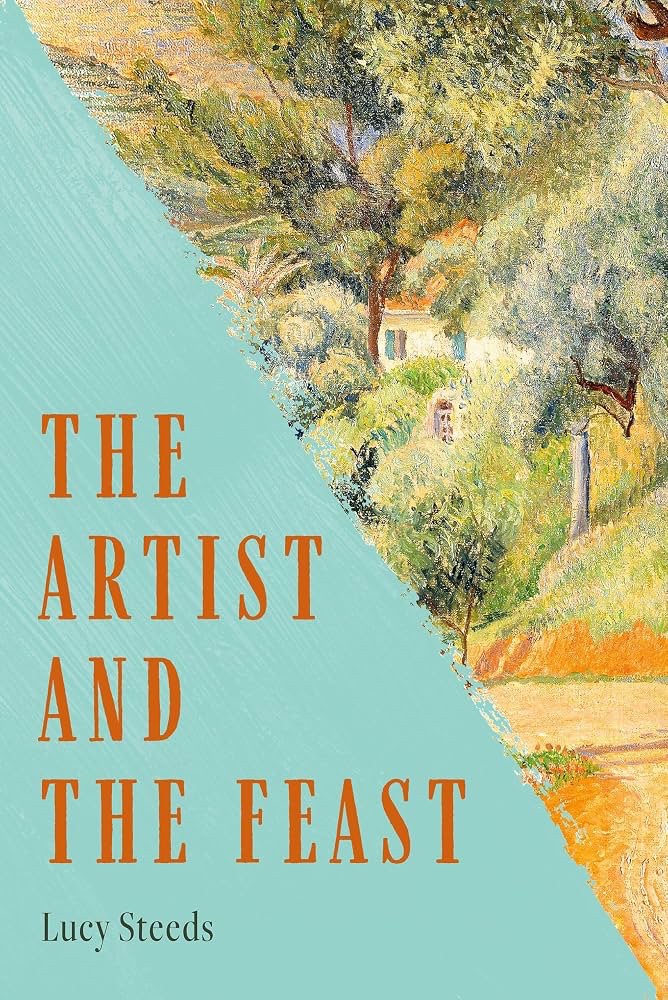
It is the one-word summons that arrives by mail, calling English journalist Joseph Adelaide to the countryside of France. With this word, he’s summoned to the home of renowned but reclusive artist Edouard Tartuffe in The Artist and the Feast.
Joseph has been waiting for this response, living in a Paris boardinghouse and hoping that he might finally be given the opportunity to tell the world about a man whose art has long been admired. But the venture is bizarre from the moment Joseph arrives at Tartuffe’s home.
For one, Tartuffe cannot read the telegram Joseph offers as proof. He has no memory of inviting the journalist. Secondly, he lives with a niece named Essie who, though quiet as if afraid to make a sound, is clearly the driving force behind her uncle’s career—and indeed, his life.
Tartuffe, or “Tata,” paints. Essie makes this possible by cooking, cleaning, minding the studio, and sorting the mail.
Questions That Disturb
The Artist and the Feast asks us, towards the end of the novel, what it means to love a monster.
We learn much about Tartuffe in the chapters written from Essie’s viewpoint. She reveals to us that her uncle detests her as much as he needs her. He detests the memory of her mother, too.
Her mother died after escaping to New York because she could no longer stand living as her brother’s servant. The trouble is that, when Essie’s mother left, she did not take the child.
As a result, Essie immediately took up all of her mother’s duties—whether she knew how to perform them or not.
Essie has felt called from childhood to create art of her own. Tartuffe destroyed those dreams—or thought that he did—by using cruel words and tearing up the pieces she was proud of.
But art is story, and story does not die so easily.
Essie soon finds other ways to follow her ambition.
Her soul is wounded, but not broken, by her uncle. And Joseph Adelaide is present at the house to witness an explosion that has been a very long time coming.
A Grief Shared
Joseph soon feels for himself the same unease that Essie has suffered from every day of her life:
“I should not fear Tata as much as I do, but there is something terrible about him, like looking into the eye of the sun. And God.”
We are never quite offered a glimpse of Tata’s childhood. Was it so filled with monsters that he became one of them?
The truth is that, to me, it does not matter if child Edouard was locked in a room with the devil himself. It is not the fault of Joseph and Essie. There is no excuse for the measures he has always taken to destroy anything that makes Essie happy, and then make it so that she has no option but to remain in his home as a slave.
It is not surprising that, trapped as she was in such an environment, Essie has developed a confused idea of what love is. Nor is it surprising that she has resorted to the solace of nightfall, the only time when she can escape his vicinity and breathe.
And in those moments of darkness, she quietly concocts a way in which she might destroy him back.
The Niece’s Revenge
Essie has never stopped painting.
She begins to copy the work of her uncle, finding solace in the process after the harrowing work of serving as a volunteer nurse during the Great War. She copies all of his work until it is impossible to tell the difference between their styles.
And then she asks herself: why is his work worth more than hers, if visually there is no difference at all? Why is there so much weight merely in his name?
He has lied and told her that women cannot go to study art. Joseph reveals the truth: certain schools are welcoming female students.
Why did Tata lie about this?
Why is he so afraid of Essie learning to use a paintbrush? Is he scared that she might leave him to care for himself in that house so far away from the world? Is he scared that she might surpass him in skill?
Is it both?
Under this dark story arc is a truly romantic subplot that I found beautiful.
Joseph sees Essie, even when she goes to great lengths to hide herself. She sees in him an honest man that she eventually trusts with her greatest secret. He sees not only a muse, but a brilliant mind, and encourages her to try once more to make art of her own.
Tata tried to muffle her, but Joseph does the opposite.
He wants to know what she has to show the world.
I believe that is true love.
Conclusion: The Artist and the Feast
The Artist and the Feast is loaded with tension from the first page. We know that something is going to explode, and we are eager to see it happen. We want to see Essie live. We want her to break free and see the world.
The novel’s ending is truly so satisfying.
What a gift of a story.
Art, and story, have always been stronger than any human attempts to stop them. A story might be “put out” for a while, but so long as there are people willing to put pen to paper, it will resurface in a new voice centuries later.
We cannot stop it any more than Tartuffe was able to.
We are storytelling creatures.
It pulses through us in our very blood.


Leave a Reply