
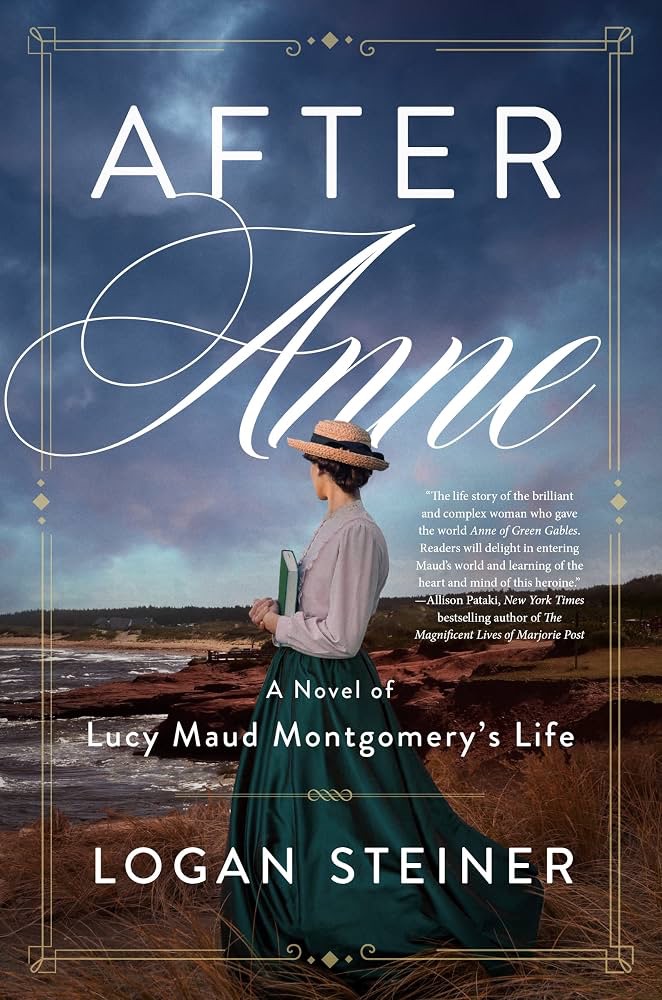
A couple of days ago, I shared my interview with Logan Steiner, author of After Anne. Her novel is a fictionalized imagining of the life of L. M. Montgomery, the Canadian author best known for Anne of Green Gables and the unforgettable Anne Shirley.
After Anne reveals a truth about Montgomery that is not often considered: she spent much of her life struggling with depression, even during the years in which she was writing about the charismatic and dreamy Anne Shirley.
Reading Steiner’s account of Maud’s struggle, it’s clear that her troubles become worse when she meets and grows to like Ewan MacGregor, the minister she will eventually marry. Ewan is not a simple villain, but he is portrayed as displaying several qualities and behaviors that we would today call red flags.
For a woman living in Maud’s time, however, the choices surrounding marriage were different. Women were expected to become wives and start families. Enough of a dreamer still lived in Maud that she hoped there would at least be feelings involved in the matter.
Steiner gives us a telling glimpse of Maud’s understanding of marriage:
“Ever since she’d first had real feelings for a man, Maud had suspected that marriage could be heaven with a man she loved, and hell with one she did not.”
Indeed, Maud repeatedly demonstrates that her heart prioritizes writing over Ewan, even after their wedding. And when I asked Steiner about this in our interview, she agreed:
“I do think Maud had a deeper love story with writing than she did with Ewan. Writing was her refuge. When those stories competed, writing inevitably came out on top, to Ewan’s dismay. That is not to say that marriage and creativity need to compete. But Maud’s story shows how difficult a creative path can be when paired with an insecure partner.”
Dreams That Won’t Settle
I thought it important to begin my review of After Anne with this point because the novel is not simply a story about a woman who wrote books.
After Anne is the story of a woman who does not want to choose between love and creativity, but is being pressured to all the same. It is the story of what happens when the thing that gives a woman life becomes a source of discomfort to the person closest to her.
In The Artist and the Feast, which I reviewed yesterday, I found a similar theme. There is a dynamic between Essie and her uncle Tata in which he cannot bear to see his niece make progress in the arts. It makes him insecure, and as a result, he does things that are evil—destroying her work and saying cruel things meant to tear her down.
When a person you live with is threatened by what you love, it can lead to a specific form of danger. Ewan MacGregor never does these things to Maud, but Steiner makes it clear that he is unhappy with many of her choices.
Ewan’s behavior is sometimes erratic, and Maud cannot ignore what remains unsaid between them. Speaking to her cousin Frede about Ewan, Maud finds herself forced to make a confession. When Frede asks:
“But Maud—you do like Ewan, don’t you?”
Maud admits:
“I do like Ewan…. But there’s a strange feeling I get sometimes around him. When I talk, you would think I was the most interesting person in the world…. But those looks also turn my stomach sometimes…. When I look in his eyes, it can be like looking in a dark tunnel….”
Maud finishes:
“Sometimes I am not so sure his long stares are about me. It is like there is a cloth covering half his face that I cannot pull aside.”
“Womanly” Ambitions
Lucy Maud Montgomery was born in Canada in 1874. After her mother died when she was very young, she was raised largely by her grandparents on Prince Edward Island, the landscape that would eventually become the setting for her beloved novels. She worked as a teacher and librarian while publishing stories and poems.
Anne of Green Gables, her breakthrough novel, was published in 1908, and she went on to write more than twenty novels. One would not have guessed from the beauty of her prose that she struggled with loneliness and despair. She died in 1942 in what has long been understood as suicide. Her journals, though edited by Montgomery herself, remain an important record of her life.
I thought that Steiner’s portrayal of Montgomery in After Anne was excellent. She reminded me of Jane Austen and Louisa May Alcott. Both of these remarkable women wrote stories about romance, but a dashing husband was never the only thing they seemed to want from life. Their books suggest a deep investment in story, imagination, and the life of the mind.
I have asked myself in the past: Did Austen and Alcott know that, once married, they would have virtually no time to write?
In After Anne, Maud finds herself rereading a letter that she wrote to Frede twelve years prior. It is a grim letter, not excited about moving forward and starting a new future. Instead, she grieves what would be lost, such as the home that she shares with her grandmother, after marriage.
Then comes a passage very much in the vein of Alcott:
“But Maud might also be an old maid with books for children and a pen for a husband. She would not be unhappy if so, she’d written, because what she’d put into life mattered more than what she got out of it.”
What’s more, it becomes evident early in their courtship that any success on Maud’s part will be uncomfortable for Ewan. In a conversation with Frede, Ewan asks about her ambition to be a professor. He smiles and says, “You’ve never spoken about [these ambitions] before.”
Frede looks him in the eye and says:
“Consider whether you would have asked [about them], had I been a man.”
I asked Steiner about this exchange, to which she replied:
“Frede put plainly what I thought many readers would feel—that societal pressures on women can run counter to living a full life. Maud and Frede’s relationship reminded me of friends in my life whose honesty and openness puts me at ease. I love being around people who say the thing without worrying constantly how someone else will hear the thing. That was Frede to Maud.”
This passage is uncomfortable, indeed. Ewan asks Frede:
“Am I to take it, then, that you don’t have any womanly ambitions?”
He adds hastily:
“I only mean—do you want a husband eventually? Or children?”
Frede gives him a firm, unflinching answer: no. Then Ewan turns to Maud and poses the same question. She wonders how the spotlight turned to her so abruptly, and she also realizes what “womanly” meant to Ewan.
Ewan considered “womanly” ambitions to mean a husband and children, of course. Not writing.
But on page 194, Maud confesses:
“Writing was what she cared about most. It was the one thing she could not bear to lose.”
She wanted, before all other things, to write. How would she make Ewan understand this?
Maud’s Lifeline
Maud’s fear of losing her writing is not unlike that of Sybil van Antwerp in The Correspondent, when she begins to lose her eyesight. But Sybil is being threatened by an actual illness; Maud’s trouble comes from an insecure man who is convinced, not only that women have one place in the world, but that her success is a threat to his place in the household.
In the novel, Ewan is not outwardly unkind. But he has deep wounds that culminate in a grim belief in his own eternal damnation. This belief creates a shadow that destroys his family and torments his wife. Maud, who was never even fully sure that she wanted to be with him, is left alone to face his personal demons.
The sting of After Anne is that the danger she faced was specific. The matter was never simply that Maud might marry the wrong man, or even that she would marry for money. It’s not even, really, that she could choose to remain a spinster.
The danger is that her choice could involve surrendering the lifeline she had already discovered in writing. Maud does not consider writing to be a hobby she could put aside when she becomes a wife. It is the thing that makes her feel most fully herself.
Ewan is not a simple villain, and Steiner does not make him one. I asked her about this, and she said:
“Like many of us, he was limited but trying, and I was intent on rounding out his character. As much as I initially wanted a different relationship for Maud, I came to understand Ewan better as I reworked his scenes. I now see their marriage as a tragedy of circumstance rather than a tale of villainy.”
Ewan’s struggles are human, even as their consequences become devastating for the people closest to him. I can sympathize with Ewan in a way that I never did with Tata, because Ewan did try, with what he could offer, to make Maud happy.
Were he and Maud a poor match? Was Maud simply not meant to marry? We’ll never know. There is something sad about watching two people enter a marriage with hopeful hearts, only to discover that love cannot always overcome what each person carries inside.
Conclusion: Finding Meaning in Words
I finished After Anne thinking about all the women writers who understood that a meaningful life could be made from something other than marriage. This could be a house full of books, a desk by a window, a good ink pen.
For Maud in After Anne, that life was not a consolation prize. It was the life she wanted. Perhaps that is what I found most moving about Logan Steiner’s portrayal of L. M. Montgomery. Anne Shirley is remembered for her enormous imagination. Anne feels great determination to make a life larger than the circumstances she was given.
Behind Anne, there lived a woman who understood that longing, herself. Maud wanted to write and make stories. Though fond of Ewan, she did not want to surrender the part of her life that belonged to her.
After Anne made me wonder what happens when a woman’s dreams refuse to settle neatly into the life imagined for her. Sometimes the dream is unwilling to be set aside. It demands that the person who carries it take it seriously.
And perhaps this is its own kind of love story.


Leave a comment