
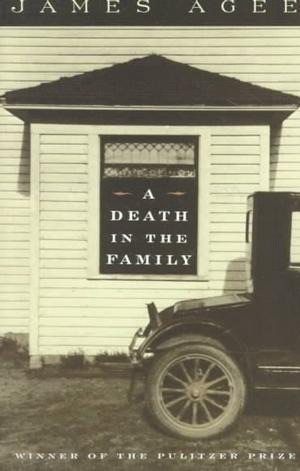
I should have known, by the novel’s title, that A Death in the Family was going to be heavy. The fact that its author, James Agee, is also dead, and that he died young, makes the novel especially haunting and poignant. I have no way of reaching out to Agee or asking him about the book; I can only come to know him through the words he left behind. And, after all, this is enough. A novelist, ultimately, wants to be known for their novels.
James Agee and A Death in the Family
An American novelist, journalist, and poet, James Agee was born in 1909 and died of a heart attack in 1955, at the age of 45. A Death in the Family was published posthumously in 1957, two years after his death, which adds something special to his words. One must wonder if he ever had a premonition of his own early demise; indeed, it would not be the first novel by a deceased person that has made me wonder about this.
Agee’s writing has the unique quality of seeing beauty in everyday things, including childhood, grief, and poverty. His descriptions seem long-winded at times, but it is worth working through them, peeling back the layers of emotion that make a novel memorable.
The novel begins when the protagonist, Jay, receives a phone call saying that his father is sick. He must go at once to visit his family and find out what has happened. On the way home, he is driving too fast and suffers a car accident that kills him instantly. The twenty chapters that follow trace a family as it navigates the first hours of grief, particularly Jay’s children, his son Rufus.
Grief and the People We Leave Behind
You couldn’t like anyone more than you happened to like them; you simply couldn’t. And you couldn’t feel more about them than that amount of liking made possible to you.
The thought crosses the mind of Jay’s wife as she waits for word about her father-in-law. It made me reflect on how, after the death of a person, everyone is compelled to think kindly of them. It seems like sacrilege to ponder their flaws or mistakes.
But in many instances, the kind thoughts exchanged after a death are dishonest, meant to soothe the conscience of the speaker. Death changes the way we remember people. Once someone is gone, we can no longer argue with them, forgive them, resent them, or ask them to explain themselves. We are left alone with our memories, and those memories can be both tender and complicated.
Rufus reflects, after his own father’s death:
He was glad his father didn’t know [about his mistake] because if his father knew he would think even worse of him than ever. But if his father’s soul was around, always, watching over them, then he knew. And that was worst of anything because there was no way to hide from a soul, and no way to talk to it, either.
This is one of the things Agee understands so well about grief: losing someone does not mean our relationship with them simply ends. We continue to think about what they knew, what they thought of us, what we wish we had said, and what we would say if we could speak to them again.
How Do You Explain Death to a Child?
How does one explain death to a child?
My heart ached to read the chapters where the adults attempted to make Rufus and his little sister, Catherine, understand that their father was never coming home. How do you explain to a young mind the magnitude of the changes that are going to rattle their world? How do you explain the idea of grief?
Their mother tells them about the wake:
But when we see Daddy today, children, his soul won’t be there. It’ll just be Daddy’s body. Very much as you’ve always seen him. But because his soul has been taken away, he will be lying down, and he will lie very still. It will be just as if he were asleep, so you must both be just as quiet as if he were asleep and you didn’t want to wake him. Quieter.
“But I do,” said Catherine.
But I do, said the young girl.
Unmoved by her mother’s religious explanation, she sees no reason why it would be wrong to try to wake the dead. Her words are not dressed and proper like those of the adults. They are honest, as only a child can be, and I find myself agreeing with her.
Religion did not soften my grief: I wanted only to wake the one who was sleeping and bring her back to the land of the living.
There is something devastatingly simple about Catherine’s response. She doesn’t understand why the adults have accepted something she cannot accept. Her father is asleep. Why shouldn’t she wake him?
Perhaps that is what makes childhood grief so painful to read. Children have not yet learned all the complicated language adults use around death. They simply know that someone they love is gone and that they want them back.
Reading A Death in the Family While Living With Grief
Books that involve grief and death hit me differently, as both are constantly on my mind. I dwell on them more than is perhaps healthy; reading this novel, so focused on these same matters and lamentations, reassured me that my mind is not the only one to have ruminated on them.
James Agee wrote a long novel exploring loss from every possible angle. He examined death through the eyes of a bereaved spouse, a grieving brother, and a confused child. My fixation may not be healthy, but I have never been alone in it.
Perhaps I will never write a novel quite this bleak. But I hope that my own writing might always be this honest.
I am more afraid of my loved ones dying than of dying myself. I have experienced that great absence, and I live with the dread that one day it will return. Books like this remind me that I am not the first person to live with such fears. I do not want to think about death all the time, but I cannot pretend that I am unusual for thinking about it.
Death is the great mystery that human beings have contemplated from the beginning of time.
A Death in the Family is a masterful study of that mystery.


Leave a comment