
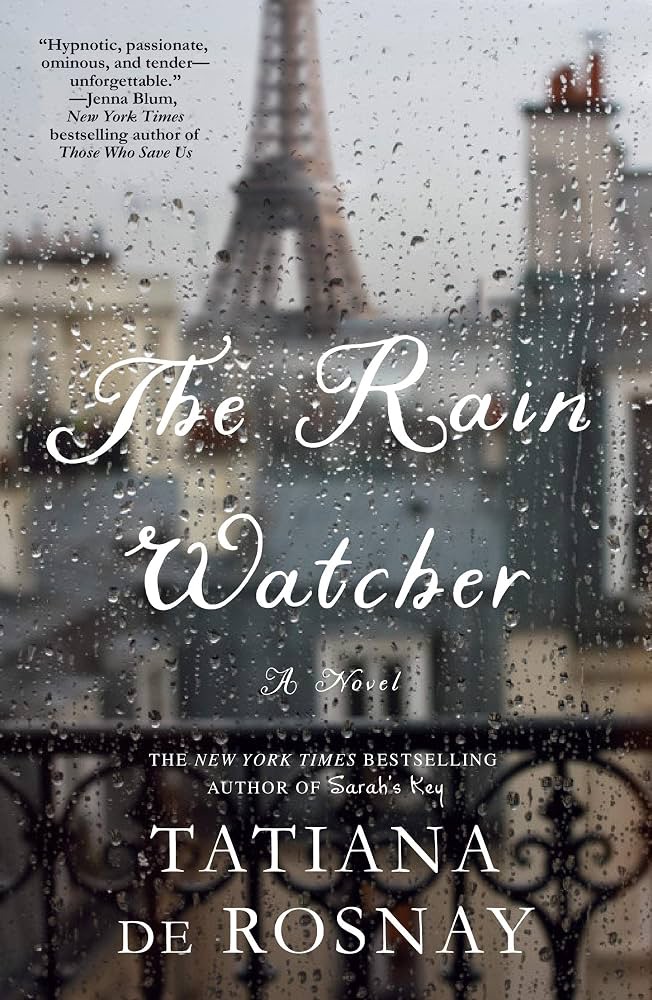
The Rain Watcher by Tatiana de Rosnay: A Novel About Family, Floods, and the Wrath of Nature
A Note on Trees
I want to begin this review of The Rain Watcher by Tatiana de Rosnay with a comment: trees are far cleverer than we give them credit for. Under the right conditions, they can live for hundreds of years, making some of them older than our major cities. In de Rosnay’s novel, we meet a character who understands the personality of trees. He loves them so much that he comes to be known as Treeman.
I would have been interested to learn more about him, but when Paul Malegarde suffers a horrific stroke, there is little opportunity for him to communicate at all. We know him mostly through flashbacks of his childhood. Though I enjoyed The Rain Watcher, I believe the novel missed an opportunity to do more with this fascinating character.
As a whole, The Rain Watcher felt like something else: a family novel in which the subject of trees sometimes seems tacked onto the larger story.
Reunion Under Water: The Plot of The Rain Watcher
The Malegarde family has agreed to meet in Paris after spending some time apart. Paul, the aforementioned Treeman, Lauren, Linden, and Tilia are gathering to celebrate Paul’s seventieth birthday. Because of the differences within the family, such a reunion was always going to be risky.
But Paris decides to make things even more complicated.
Heavy rain causes catastrophic flooding across the city, creating an almost apocalyptic backdrop for the family’s reunion. During his birthday dinner, Paul is giving a speech when he suffers a horrific stroke and is rushed to the hospital. But during a flood of this magnitude, even the hospital is not guaranteed to be a safe place. The water spares very little of Paris, and the levels continue to rise.
Linden has never had a warm relationship with his father. After discovering in school that he was gay, he did everything he could to put space between himself and Paul. He does not know how his father will see him if he tells the truth. He has reason to doubt: his mother already reacted poorly when he came out to her.
A chasm has therefore long existed between Linden and his father, one that he is forced to cross following Paul’s stroke, as Linden becomes the one who goes to keep his father company at the hospital.
However, more powerful than all of this emotional noise is the flood.
Perhaps de Rosnay did this deliberately. Nature and its merciless wrath dominate everything the characters believe is important.
All that we live and fight for is nothing in the face of the flood.
The Wrath of the River
There is a flashback scene in which Linden, as a child, goes with his father on an excursion up Lance Mountain:
The splendor of the image remained imprinted in his mind. His father finally spoke. He said it all seemed calm, so peaceful, didn’t it? Linden nodded. His father then said something he never forgot. When nature got angry, Paul said, there was nothing man could do about it. Nothing at all.
The mood underlying The Rain Watcher is bleak. Readers are repeatedly reminded that, in disasters like this, our notion of time means very little.
A tree is outwardly quiet and simple, but it may have seen more years than we could imagine. Floodwater can quickly destroy things that humans spent centuries building with their hands.
With all our clever inventions, we are not, and never have been, entirely in control. If humanity were suddenly to vanish, a tree with steadier roots would fare better than any house we ever built.
“A tree is just as much alive as they were,” Paul told his little boy, lifting him up so he could also touch the rugged, coarse surface. “A tree must fight for survival,” his father told him, “and it must do this every single second.”
Linden is forced to take on the role of head of the family when his mother becomes sick with the flu, almost at the same time as her husband’s stroke. Linden has always had the sense that he needed to prove himself to his father. Now Paul is seriously ill and Lauren is sick.
Linden is forced, unwillingly, into the role of leading his family through a storm, both literal and figurative.
What the Rain Hides
The Rain Watcher hinges on the whims of nature. During a storm, it can seem as though there is not a whole lot going on, but de Rosnay reminds us that while a storm might stop traffic, a thousand other things are happening: hellos and goodbyes are being said, dreams are being achieved, and dreams are being forsaken.
Life and nature move at their own speeds. It is futile to try to be in control.
Linden tells his father all the things he has kept inside. His father has no way of responding. Time moves at its own pace.
But Paul has one final thing to tell his son.
He communicates through a specialist assigned by the hospital to stroke patients, who writes down instructions Paul gives to Linden. These instructions lead Linden to his family home, where he is supposed to look inside an old tree.
There, inside a tin box, he finds a confession concerning an event that took place when Paul was a child and left a wound in him that never healed.
A truth for a truth.
I understand what de Rosnay was trying to do with this part of the novel, but it seemed a bit forced to me. Told in interludes, Paul’s confession sometimes seemed to distract from rather than deepen the central story.
The tree material works best when it illuminates The Rain Watcher’s larger meditation on time, mortality, and humanity’s smallness in the face of nature. When it becomes another piece of family history to be uncovered, it feels considerably less organic.
In spite of these flaws, I did enjoy The Rain Watcher, and Linden is one of my favorite characters that I have “met” this year.
An apocalypse doesn’t always involve a sinister pace. Far less predictable, and more unsettling, is the rain.


Leave a comment