
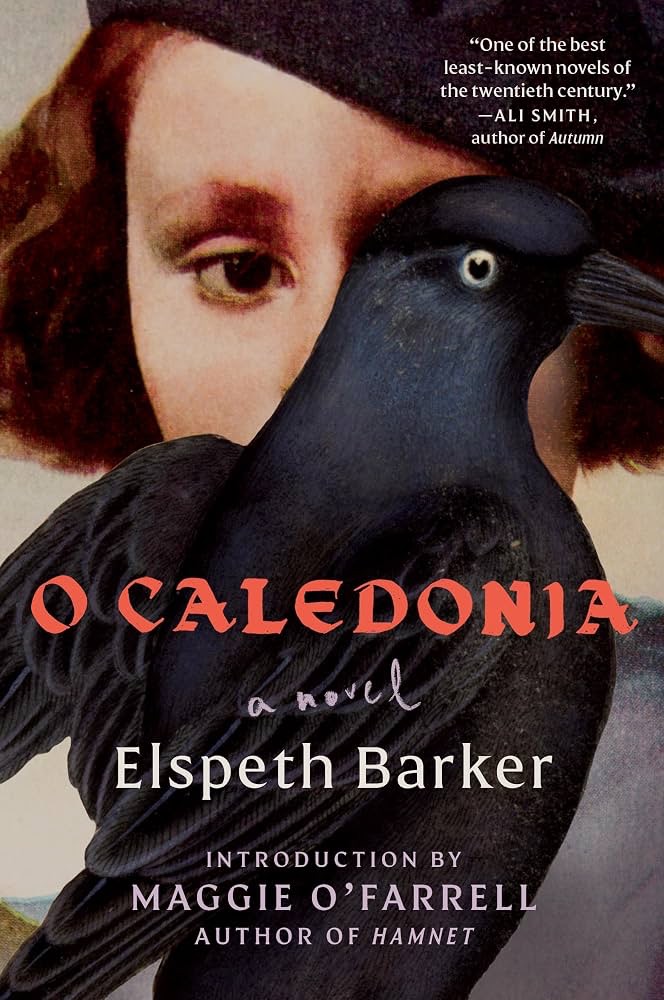
The great tragedy I have discovered this year is when I read a great novel but cannot think of reaching out to the author because they are dead. A few days ago, I discovered A Death in the Family by James Agee and quietly grieved, for Agee died young. In the case of O Caledonia, Elspeth Barker just died in 2022, a year close enough to feel cruel and taunting.
What strikes me first is the revelation in the introduction by Maggie O’Farrell: this was Barker’s only novel. She was a known literary columnist, but, as far as is known, she did not write another long-form piece of fiction. This intense, stand-alone novel has exploded into fame after the death of its author. I have no reason to despair: I might have a new novel, The Novel, in me yet; perhaps I will encounter it in old age.
The character, Janet, is a bookish daydreamer who has never fit in in her world or with her family. This passage from the first chapter struck me:
When she was older she intended to be a princess. Almost as much as its image she loved the word, with its tight beginning and its rustling, cascading end, like the gown a princess would wear, with a tiny waist and ruffles and trains of swirling silken skirts.
I find it endearing that Barker took the time to explain why a single word is so beautiful. I, too, have had such thoughts, both on words I like and words I despise; I’ve never thought to slow down and put these thoughts into words. But it made the rest of the novel feel so relatable. To dwell on a word and the sounds in it is so very human.
We know from the introduction that Janet is going to be found dead, but the novel itself passes like a fever dream. It is full of bizarre scenes, though we cannot quite see how it will escalate from teenage drama and sibling rivalry to death. After Janet is found dead, the neighbors’ comments are eerie but not really unbelievable, as humans tend to blame the wrong person:
So they blamed the mother for giving the child all those books to read: “It’s not natural for a bairn”; they blamed the father for his ideas about education; they blamed everyone and everything they could think of, but in the end there was grim assent: “the lass had only herself to blame.”
This has been said, at some point, about every woman: “She has only herself to blame.” Janet’s sixteen years are full of instances where she is harmed, and she is the victim, but society manages somehow to pin responsibility on her. Yet she continues to walk her own path, taking pride in being different. She is remarkably strong as the years pass and her dignity is repeatedly challenged. Up to her final moment, she is unapologetic about her beliefs.
Many scenes in this novel are so purely imagined that, in spite of the subject matter, I had the impression that I was reading a beloved first work — an unfiltered manuscript by an author who does not really care to placate the audience. Given that O Caledonia is Barker’s only novel, it’s not unreasonable to think this went on at times. Janet explores her world with the wide-eyed wonder of Anne Shirley, except Janet’s world is darker; Janet’s life is also sadly devoid of kindred spirits.
Janet spends most of her life not fitting in, not even able to uphold a conversation with her mother until she researches in popular magazines and learns to talk “of A-line dresses and pencil skirts, of shot taffeta ball gowns and fashion’s hideous new colour, shocking pink.” This banter pleases her mother enough that Janet finds the courage to ask for a book. “Vera remembered the books stacked slithering and topsy-turvy all over Janet’s bedroom floor. Why add to them?” But, in that instance, her mother does assent.
If Elspeth Barker were alive, I’d be trying to reach out to her. I would have so much to ask: how did her one novel turn out to be so powerful in its oddness? But perhaps it’s necessary for us to put our questions away in order to just enjoy a story. A classic like this is clearly able to speak for itself. Janet dies in the final chapter, but clearly she is not dead — neither, I believe, is the author behind her.
Sometimes Janet thought that life’s sole purpose was to teach one how to die. As in most spheres, so in this, animals did better than people.
Sometimes the most important thing a novel can do is teach us how to die — as well as how not to. In her one novel, Elspeth Barker did both.


Leave a Reply