• Review: After Alice by Gregory Maguire

    Written by a master storyteller, After Alice might be the richest Alice in Wonderland retelling available if you’re looking for lyrical writing and elaborate description. I wanted to quote every other sentence or store it away in my memory, hoping Maguire’s genius might rub off.

    The plot, however, is okay at best.

    Our main character, Ada, is daunted by the responsibility of being a new big sister. In a moment of anxiety she runs away from her governess and from home, where she comes across Lydia—Alice’s sister—who claims Alice has vanished again before sending Ada off.

    Moments later Ada finds herself in the same strange world—Alice has been there, because people know who she is. Since Alice is her only friend, Ada takes it upon herself to find her and bring her back home, but in a place where nothing makes sense that might be nearly impossible.

    There are new characters, including a freed slave boy named Siam—and Charles Darwin! I might have to read the book again to understand the connection between Darwin and Alice’s Wonderland. Alice’s sister Lydia distracted me in scenes featuring the old man by flirting shamelessly with his American companion, Mr. Winters…

    Aside from the curious presence of Charles Darwin, this was a typical Alice retelling; the nonsense is there, talking plants and a Cheshire Cat. The strange creatures Ada encounters are maddening as ever; I had the constant urge to shake them.

    If you’re looking for a mind-blowing rendition of the classic, After Alice might disappoint; however, I suggest you give it a try for the writing alone. Few books these days have such a firm, beautiful control on description and language.

    It might not have been my favorite book by Gregory Maguire, but I myself am not disappointed. I wanted a good story from a master, and it was indeed a good story (not great.)

    I can only hope one day I’ll be able to write like him.

  • Review: Never Never by Brianna R. Shrum

    Readers have been enchanted by the tale of Peter Pan for generations, sympathizing with the boy who didn’t want to grow up and the children who went on an adventure with him. Having read the book twice, it was exciting to find Never Never at the bookstore–because it sheds more light on the legendary Neverland.

    When it comes to villains in a story, there’s so much we don’t know. Why did this person turn bitter and hateful? Which events turned him into such a haunted soul?

    Never Never painted such a beautiful and sad past for Captain Hook. The tables had turned when I closed the book—it was Pan I hated most.

    James Hook is a boy who has only one dream: To be a pirate. In real life, though, he longs to become a man and make his father proud. These two desires make for a powerful character, given that he’s only a boy when the novel starts, preparing to head off to boarding school.

    That’s when he meets Peter Pan who tells him about the place Neverland, where children don’t have to grow up. Even though he wants to be a man and make his father proud, he wants to see the pirates; he agrees to go with Peter to visit, trusting that he’ll be returned in time to go to Eton.

    But Peter does not keep that promise; he forgets it instantaneously after their arrival at Neverland, also forgetting that James never wanted to become a Lost Boy. James followed him to Neverland as a visitor; now he’s trapped following the whims of a scatterbrained boy who turns out to be a dictator.

    When James breaks Peter’s greatest rule and begins to grow up, he runs away to the pirate ship Spanish Main, where he’s received as captain without question. The Main was always his dream, one Peter somehow brought to Neverland.

    The sweeping novel chronicles James’ struggle to adapt as pirate captain in a place he’s beginning to hate, because it belongs to Peter; everything works at Peter’s whim, including the weather. Neverdays seem to last a lifetime, and there are so many scenes which broke my heart; in the end we find the soul of a person we grew up seeing as villain.

    Fans of Peter Pan, misunderstood characters, and book spin-offs will enjoy Never Never. It’ll make you angry, it’ll have you tearing up; most of all, you’ll sympathize with someone you despised as a child.

    Things are not always what they seem. By the end of Never Never you’ll probably hate the Pan, too.

  • Why Writers Don’t Have to Drink Coffee

    For many writers, coffee’s essential in order to practice the craft. It gives us energy, smells good, and there are many ways to drink it—you can add creamer or take it black (I love it both ways!)

    I, too, swore on coffee being the writer’s drink—until my mom got me a brilliant cocoa-latte machine. After experimenting with different things in the recipe booklet, I realized we shouldn’t limit ourselves to coffee.

    Your cure to Writer’s Block might be simple as choosing a different hot (or cold) beverage!

    Recently, homemade hot chocolate’s been my favorite when it’s time to write or edit. I’ve also tried a hot Nutella drink and a variation made with dulce de leche (if you haven’t tried this Argentine delicacy, do. It’s so sweet, you may only be able to handle one spoonful!) Other days I need a classic cup of warm tea. Since springtime weather has come, I’m planning to make cold drinks—special lemonades, iced coffee, even smoothies.

    The point of this post is we shouldn’t confine the craft to one age group, genre, or drink. I used to look at people who preferred tea with suspicious eyes, but this winter realized that limiting our writing to one beverage is like forcing us all to follow the same storyline.

    Writers shouldn’t be limited to the workspace habits of others. We build our own, choosing how to organize our desks, even picking which pens to write with. Believe it or not, this does make a difference!

    Don’t let anyone force you to drink coffee. I encourage you to experiment before you decide it’s not for you, since a lot can be done to ‘customize’ it; however, don’t do it because you feel pressured.

    You can be a writer and not like coffee. You can even be a writer and not like tea. Be a writer by being you.

    Choose your favorite writing beverage, make a playlist your muse enjoys, write in a shadowy corner or a sunny spot in the yard. I believe we would get more original stories if people would walk away from stereotypes, embracing themselves as individuals.

    What do you drink while writing—coffee, lemonade, or plain old water? Do you write in a cafe or your comfy bedroom? Do you listen to indie music or classic rock?

    Choose what feels right for you, for the sake of your story!

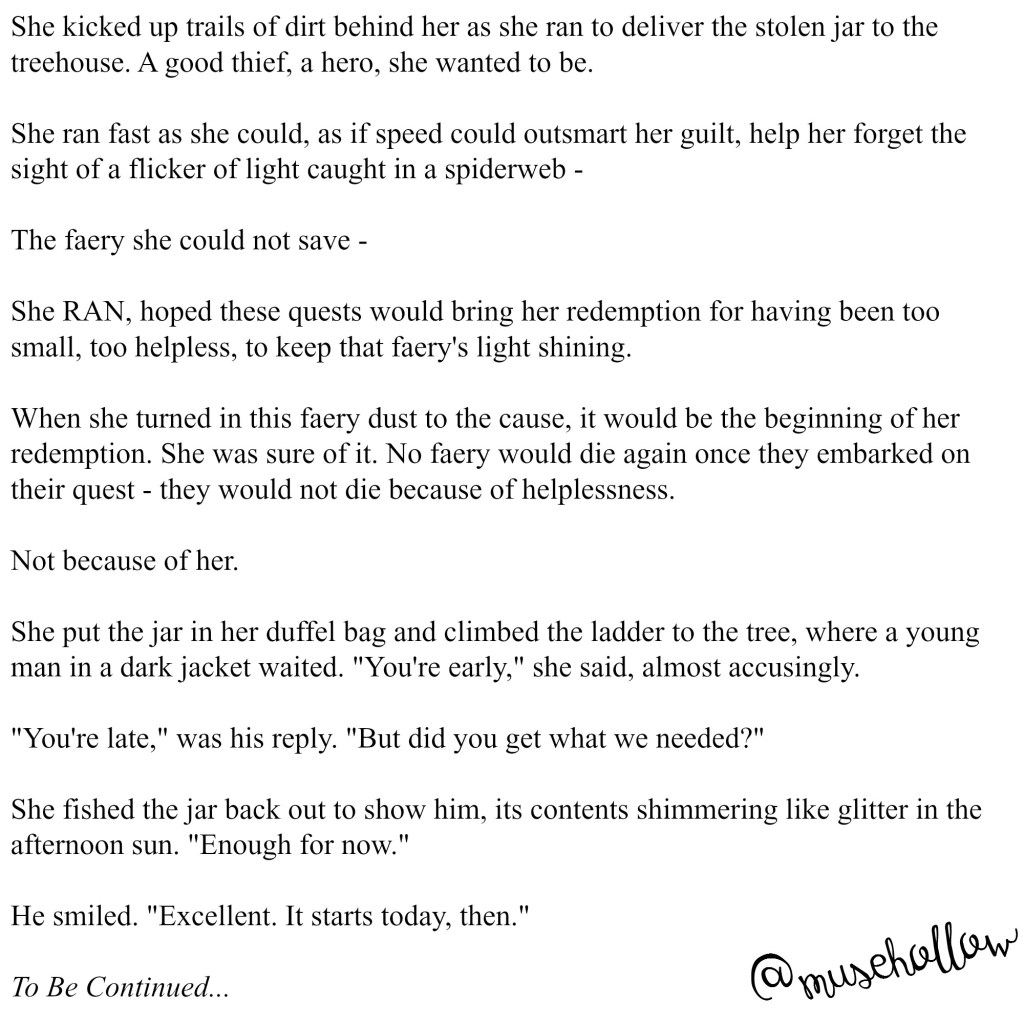
  • Tale: Running with Faery Dust
  • Review: The Darkest Part of the Forest by Holly Black

    The Darkest Part of the Forest is a must-read for any faery tale lover, especially the tales where Fae are tricksters, inflicting chaos on unsuspecting humans. Fairfold is a little town located near a forest teeming with faeries; they live in tentative harmony, though the humans resort to superstition in order to avoid tricks. It’s been unusual but quiet in Fairfold for many years—but that’s about to end. The horned boy in the glass coffin wakes up, and with him chaos stirs.

    I didn’t like the main character, Hazel, at first. There’s nothing special about her, and though we learn later that it was done intentionally, in the first chapter I wondered why she was the main character. Others—like her brother Ben, or his friend Jack—seemed more worthy of the title of protagonist. Of course later we learn there was more to her than the plain girl who kissed lots of boys.

    But what we’re really interested in is the horned boy who’s slept in the glass coffin since Hazel and Ben’s parents moved to Fairfold. The glass has been beaten, screamed at, kicked, defiled, but nothing wakes him up. Hazel and Ben have always wanted to wake him, but could never have imagined what would actually happen when he did wake—never predict he would have such a bizarre personality, or lead them into a world so dark and frightening.

    The Alderking rules over Fae who live perpetually dancing, drinking, eating, causing trouble to humans—but they aren’t truly free. I don’t think they know what happiness is, because they don’t know true love. The one time true love did come about, the Alderking put an end to it—something I can’t elaborate on without spoiling things. These Fae are not happy so they pick on the humans. I loved this idea of them.

    Hazel seems so plain in the beginning, but I closed the book thinking I really wanted to be her, to live where she did, to have the friends she did. This is a book that swept me away; the writing was fantastic, poetic, creating vivid imagery in my head. It would be a great springtime read for anyone who likes faeries, mythology, and complicated characters.

  • Tale: The Faery Dust Hoarder
  • The Start of Serenade Beta

    Well, guys–it’s begun.

    Earlier this year I completed a draft of Serenade coherent enough to show other people, but since it’s still a little rusty, it’s time to enter the beta reading phase. What is beta reading? It means I find people I trust who are willing to give me some of their time in order to help make Serenade the best it can be.

    This is a frightening phase for the writer. I’m second-guessing every scene I wrote and was proud of; I’m afraid the characters are unrealistic or that the entire storyline will come off as a joke. When I slip into moments of such panic, I have to remind myself that beta readers are here to help mend any such errors. I have to trust that they’ll help make this book into a diamond.

    It hasn’t been a year since I published Dissonance, and already I am weaving together the next adventure for my beloved characters. Serenade still won’t be out for a while (and there’s the possibility of a title change by the time all this is finished.) Using the notes my beta readers take, I’ll be working on it again in the autumn and arranging for publication in the winter.

    I remember when four years ago I wanted nothing but to be an author. Now I am, and it never really gets easier, but with friends to help and support me–as well as the lovely reviews I get, even honest ones!–it’s totally worth it.

    While beta readers tackle Serenade, I’m working on a few other projects, including my next blog serial expected to launch in the summer, and musehollow–a collection of shorter fiction. I want to learn to write good stories, short stories, and poetry. Yesterday I published the first musehollow tale here!

    I’m living the dream–even the editing, the work, is part of the dream. Thanks for being with me through all of this, and I can’t wait until you can read Serenade too!


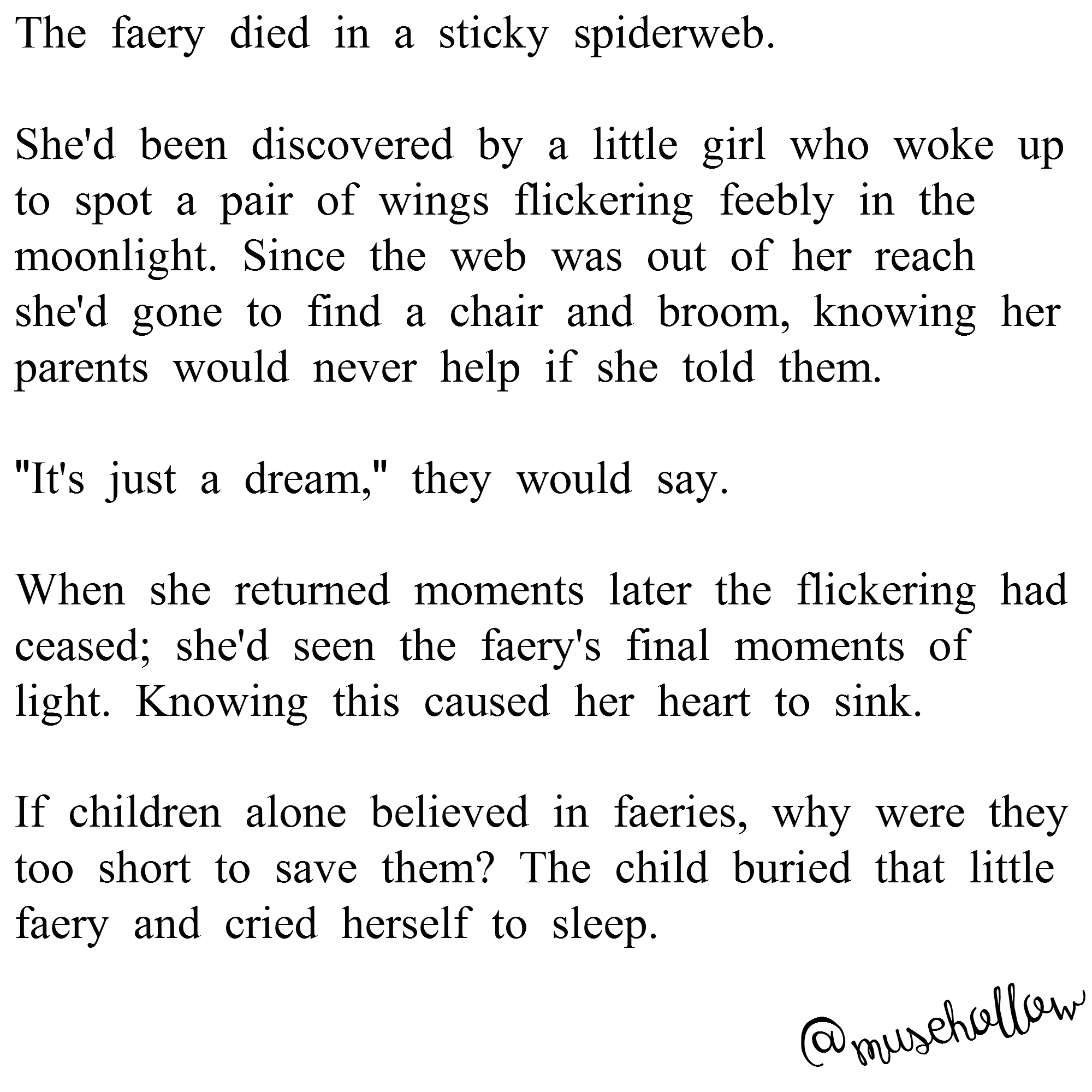
  • Tale: The Faery’s Last Flicker
  • What the World Needs Now

    What the World Needs Now


    needs

    Have you ever gotten an urge to write something from the bottom of your heart—only to be intimidated by some unnameable force insisting that you smooth the edges until it no longer sounds like you? That urge to fit in and not ruffle feathers…that urge to be like other people so you won’t draw attention…

    It may lead you to hit Backspace every time you complete a sentence, starting over with something that’ll sound ‘better.’ Then it’ll make you hesitate before you click Publish or even share a snippet with friends; it’s an irrational fear many of us don’t even want to admit we have.

    For those of us already creative, that urge makes us box our potential so it isn’t explosive. We swallow beautiful words because they’re too different for society; we’ll water them down so they no longer have an impact. If a person has yet to find their creative medium, it’ll have a more tragic effect: This person will never try to create, labeling any form of art as a waste of time.

    I’m not talking about Writer’s Block, but reluctance to show the world one’s true colors from fear of being judged. Sometimes we don’t think we’re bright enough, or maybe we fear our colors are so bold they’ll blind anyone who walks past us.

    What we don’t realize is the world needs more people who’ll glow so brightly with new ideas and creations that they’ll pour magic into a shadowy room.

    The creative life is lived both selfishly and for others—that is, we create to find fulfillment but a story ultimately wants to be told. It’s a peculiar balance of doing our own thing and worrying how others will perceive it. Of course it’s all perception in the end—we can’t force someone to like our work—but face it, every creator craves that feeling when someone enjoys our work and says so.

    Imagine how much more satisfying that’d feel if we stopped smoothing the edges of our message to create art that was purely ours. Imagine if our messages shone so brightly, they illuminated the room to catch the sight of more people, changing more lives.

    It all starts with accepting ourselves for who we are. We should never go after the artist stereotype, because that changes over the years; what the world needs now, at a time so devoid of hope and color, is art with meaning. Art so outrageous and explosive that we will inspire other people to glow as well.

    Don’t blur the edges until you’re telling someone else’s story! What we need are original, refreshing, dangerous tales. We need you—yes, you.

  • Poem: Old Words


    old words

    old words
    on crisp paper,

    new words
    in my racing mind…

    ideas vanishing
    like vapor,

    foreign colors –
    make me blind…

    love is written
    with four letters

    symbols – stare
    until they’re vague;

    humans chasing it,
    like beggars

    fail to find it,
    die of rage –

    for old words
    on crisp paper

    undying love
    can’t always make;

    ideas vanishing
    like vapor

    all sorts of
    illusions, fake –

    love is spelled
    in sets of four

    but humans break
    it into two.

    we shouldn’t trap
    it anymore,

    we should make
    way for new.

    your old words
    on crisp paper

    if bent enough
    eventually break;

    ideas vanishing
    like vapor

    after your
    illusions take.


  • Read the other stories–In the Silence and The Sailor’s Son!

    Learn more about the giveaway here!

    This is my personal favorite. I hope you enjoy it!

    aboutgiveaway


    Tyson had always preferred going places on foot, seeking open space as if it could help him control the strange power within him. For as long as he could remember, he’d felt an explosive in his chest instead of a heart, fire pulsing through his veins even in the calmest of times.

    In closed spaces he was an even bigger threat. If that explosive in his chest went off in the house, there was no chance of people running. In the house, Tyson always kept a distance from his family—knowing it wouldn’t help forever.

    And yesterday he’d finally lost control. Now that his life was over, he looked at his reflection in the car window and saw what he truly was: A daemon.

    I hate cars, he thought, tracing patterns on the window. When Tyson doodled without thinking, he always wound up creating tongues of fire like the one that ended his life.

    It smelled like lavender in this car, but Tyson suspected his presence was corrupting it with the odor of smoke. He didn’t know why the strange man with the silver car was so keen on helping him. He’d found Tyson in a shoddy old neighborhood, looking for an abandoned place to hide. He’d been looking for a shack where no one would find him unless they followed his trail of smoke.

    The man’s wife hadn’t protested to letting Tyson into their spotless car. In fact, she practically shoved him in the back with their son who, though he said nothing aloud, watched the daemon with his nose in the air.

    If they were hauling him to an orphanage, Tyson would find a way to escape. He couldn’t afford exploding again in the presence of other children. He dared hope, vaguely, that they would offer him some food before leaving him to charity. Tyson was already a daemon, it made no difference if he stole a cheeseburger from them before vanishing into thin air.

    The blonde woman in the passenger seat turned, holding out a pile of neatly folded clothes. “These are for you,” she whispered.

    She had knowing blue eyes. Tyson sensed that her words would have calmed anyone else like healing water, but he couldn’t bear to get wet. His world was one of sulfur, ash thickening his memory; smoke blurred the details, leaving only the ache of self-hatred and rejection.

    Daemon, they had always called him; now he knew it was true.

    He took the clothes selfishly, even though he knew he’d ruin them when he ran away. The thought brought him a pang of guilt, for something in her eyes made him trust her even though they were opposites—she with her soul of healing water, while his was of smoke and death.

    The man who was driving found Tyson days before. He proceeded to ask questions about why Tyson was alone, where his parents had gone, why he was in such a bad neighborhood. The daemon knew better than to say the truth: That he’d been looking for a place to haunt, the prison where he’d live the remainder of his life.

    This man persisted, finding him again and coaxing him into the car. He even brought his family the second time, perhaps in case he needed to wrestle Tyson to the ground. The daemon fixed his gaze on the clothes; if he looked into that woman’s eyes, her kindness would shake his resolve.

    “You don’t have to tell us what happened,” the man said as he drove. “Not yet. But we want to help.”

    He had the accent of a foreigner—Italian, Tyson guessed—but his wife spoke like an American. The boy sitting next to him hadn’t said a word; he was the only person in this car treating Tyson as he deserved, like a criminal.

    Should Tyson tell them what happened? He wasn’t ready to recount it, not yet, not while the echo of his sister’s dying screams fresh in his mind. Not with smoke still blurring his eyes, unwanted tears he deserved.

    He closed his eyes, succumbing to the dreaded memory.

    *

    She’d been playing in the attic, where Father built her a dollhouse with wood from the forest behind their home. He was a talented toymaker; that dollhouse had lined pillars, a thatched roof, lace curtains…

    “Tyson!” she had screamed down the stairs. “I can’t reach Emma!” Emma was her favorite doll, the one she venerated like a real person.

    The boy made a frustrated sound. He’d been trying to finish his charcoal drawing, his hands black from the stick he was using. Normally he helped her reach things on the shelf, but he’d been utterly absorbed in the piece…

    “Use your stool, Hailey,” he retorted, making a thick and pronounced line of charcoal across the sketchbook page.

    She must have tried using the stool but failed, because a brief pause ensued. Then she shouted again, “Tyson!”

    Another pronounced line. “I’m busy.”

    “TY—”

    His stick of charcoal slid off the page, leaving a smudge on the tablecloth. Mother would kill him for that. Tyson felt a wave of fear and anger creep over his body, and the dark energy in his soul slipped from his control.

    Suddenly the house smelled of smoke…

    *

    “What’s your name?” the woman in the passenger seat whispered.

    Tyson’s hands were trembling; he needed to leave the car before he killed an entire family. “No one needs to know,” he said through his teeth, peering out the window at the shadowy English road. “I want to get out.”

    “You aren’t going anywhere,” said the man. “We know what you are.”

    “Then why am I in your car?” Tyson shouted, exploding for the first time since the man found him. “Why would you want a daemon in your car?”

    “Yes,” said the blonde boy suddenly, breaking his silence. He spoke carefully in even tones, like a professor or a general. “Why is that, Giulino?”

    “Julian,” the man snapped. “Be kind, Peter, or say nothing.”

    “You aren’t a daemon,” the woman added, turning in her seat to fix Tyson with those eyes. “You’re a Changeling, and there are ways to control—”

    “It’s too late for that!” Tyson realized he was sobbing between words. “What’s the point controlling myself when I already killed my sister?”

    He felt Peter inch away.

    “Because you didn’t mean to,” said the man—Julian, Giulino, whatever—“because you didn’t ask for these abilities, and they don’t have to be bad.”

    “My sister is dead!” Tyson shouted. “Because of me! She’s dead!”

    The woman’s eyes clouded over. He feared for a moment he’d made her cry, but her words were steady. “It was a terrible accident,” she whispered. “It’s never going to stop hurting, but you deserve a new life.”

    “No,” he choked, “you should kill me.”

    “We are going to love you,” she told him, almost a command. He broke into tears just then, lacking the willpower to argue. He turned to the window, unable to stop the tears sliding down his cheeks—water instead of fire—misery instead of anger.

    Daemon, they’d called him since he was a baby. Mother always said it; Father refused to make him toys, because he feared Tyson’s red eyes. No one had ever loved him like they did his sister; this woman must be an angel if she could love a daemon.

    He closed his eyes, allowing this family to take him away. He shouldn’t be allowed to make his own decisions. If they refused to send this daemon to jail, he would succumb to their control.

    Peter’s shoulders relaxed; perhaps it settled his nerves to see Tyson cry. He clasped his hands in his lap, addressing the daemon for the first time: “What’s your name?”

    A sob escaped him. “Tyson,” choked the daemon, hating the sound of his name, how the T came powerfully like an explosion. “My name is Tyson Rakes.”

    “You’re one of us now, Tyson,” the man at the wheel said, looking at him in the rear-view mirror. “And we’re going to help you control your ability.”

    Tyson said nothing. They might help him learn to control his ability, but nothing would erase the guilt from in his firecracker heart. They drove into the night, leaving him to wallow in miserable silence.

    He was tempted to reply and say Good luck helping a daemon.


    Question #3: Why is Tyson crying?


  • Here is the second story for the Dissonance giveaway! (If you just found out about this and want to know details about how to win, click here!) Reads for the first story and responses to that question still count, you can find it here!

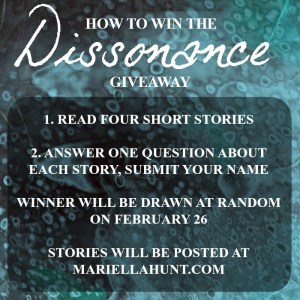
    Thanks for joining me, and I hope you enjoy! Again, here is the lovely graphic explaining simply how to win!
    aboutgiveaway


    David West had given his old denim jacket good use. He never explained his attachment to the thing, but now it was battered and threadbare. The material was too soft and it smelled of the ocean, testament to the times Peter spent with his father out on the boats.

    Peter hounded his dad to get a new jacket countless times, especially when the buttons began to come off. Now he was the one wearing it.

    He picked at the last remaining button he’d secured to the cuff with extra thread. Memory of that hounding filled him with regret. Not long ago this jacket was a cause of embarrassment, but after David’s death, Peter picked up many habits he had once despised.

    He still didn’t understand Dad’s attachment to the jacket, but it didn’t matter. Peter sometimes thought he would die wearing it; sometimes he fell asleep wearing it, though his father’s scent was long gone. It kept him warm where his father’s embrace once did, this ratty jacket he’d once despised.

    Just like Dad, he refused to part with it, even when Enna offered to buy him a new one.

    Road trips made it too easy to get caught up in sad memories. They were headed to the plantation, and had been on the road for several hours. Last time they visited, Peter hadn’t left the car. It had been too soon after the accident; he couldn’t marvel at Julian’s magical world without Dad in it.

    A year had passed and Peter wasn’t sure he believed the things Julian told him. More than that, he wasn’t sure if he disbelieved on purpose for the sheer delight of exasperating the Muse—like last week, when he finally lost his patience.

    “We were friends before,” Julian cried last week, “and you believed me! Why would I lie to you now?”

    Peter hadn’t responded. In the past he’d accepted Julian’s tales because David never questioned them.

    Dad’s not coming back, said the voice in Peter’s head he hated. It’s time to make your own judgments.

    He tuned it out, letting the monotonous crunch of tires on pavement numb his mind into silence.

    Before long they’d turned up a driveway, heading for a sprawling plantation with creamy yellow walls. The air around it appeared to shimmer with power Julian said was present—proof the Muse was not lying, proof Peter refused to accept.

    But Dad’s not coming back.

    “Are you awake back there?” Enna asked over her shoulder.

    He could not be mad at her. Julian was easy to snap at, but his wife only tried to be a friend. “Yeah,” Peter replied.

    She peered at him with a faint smile. “You’re quiet.”

    Peter shrugged and nodded to the book next to him. It told of explorers who conquered the ocean; it spoke of ships and brave captains who sailed them. One of Dad’s books—his name was written on the front page, David James West.

    A sad glint darkened Enna’s smile when she turned away. She didn’t drag on the conversation, giving him space like she promised on the morning after the accident. Peter liked her, but wasn’t sure about her husband. The Muse had once been his best friend; now there was a chasm between them, and it was probably of Peter’s making.

    Julian broke the silence, asking a tentative question: “Do you want to go in? I imagine there’ll be lunch.”

    Peter imagined what his dad would say—We’re going inside, boy, you haven’t eaten all day. It’s rude to hide in the car. Julian never did that, keeping his distance as if scared of Peter, who would fight if the Muse told him what to do.

    This time Julian hadn’t ordered him in, asking if he wanted to. Peter did feel rather hungry, so he replied: “Yes, I do.”

    The Muse raised both eyebrows in surprise at the sound of Peter’s voice. He exchanged a glance with his wife. Peter bit the inside his cheek; they made him feel like a badly behaved puppy who’d finally learned a trick.

    “You’ll like it in there,” Enna promised. “The architecture is beautiful. They have a lot of sailing relics, too,” she added as an afterthought, triggering in him a rare spark of interest.

    Peter hadn’t gone sailing since the accident. He tried filling the void with books about sailors, but words on a page did no justice to the freedom he felt at sea. Seeing maritime objects in person might fill the void a little.

    God, he missed his dad.

    “How should we behave?” Enna asked her husband, as he switched the car off. “Are we in mourning?”

    Peter remembered the baffling announcement Julian made earlier that week. One of the twins who lived in the plantation had gone missing. She vanished without a trace; none of the search parties had any luck to this day.

    Julian tapped at the steering wheel, torn. “Perhaps it’s best to only speak of Georgiana if she’s brought up.”

    “It’s still her house, though. Wouldn’t it be rude to pretend nothing happened?”

    Peter listened, sliding the book into his backpack. He’d never met the twins, because the last time they came he’d been hiding in the car. However, he sensed a supernatural sadness in the glimmering fields. The Van Meteren plantation was in mourning.

    “Let’s not make it the dominant topic, darling,” said Julian, taking her hand. “I’m sure by now he’s had plenty of guests give condolences, not knowing for sure if she’s dead.”

    Enna nodded with a sigh, holding his gaze as if searching for stability. Peter watched, torn. He’d always harbored the guilt of an intruder, having joined them six months after their wedding. They had a magic bond stronger than marriage, one he’d never understand.

    Dad knew about this bond. When Peter asked about it, he said Enna saved Julian’s life. He was careful to cloak the details, as if masking a crime.

    “Let’s go, then,” Enna said, turning to Peter with the smile she always had for him. “I’m sure they’ll let you explore.”

    Explore. He almost smiled, egged on by the word he’d read so many times in his book. It might not be an ocean and he wasn’t in a boat, but he needed an adventure.

    He slung the backpack over his shoulder and followed them up the sidewalk. It smelled like roses and rainwater, though the ground was dry. The calendar said it was July, but the weather was mild for the south.

    As if reading Peter’s mind, Julian said, “We aren’t in Alabama anymore. We’re in a place called Bonifay.”

    He knocked at the front door, assuming a confident gait he always wore when meeting other Muses.

    Perhaps it was the Muse’s confidence, but this time Peter didn’t question his claim. If Julian said they’d taken a left turn into a different universe, Peter didn’t need evidence. His life was chaotic to begin with.

    The door opened a heartbeat later. Peter tried to look dignified in his ratty jacket. Lear Van Meteren looked like he’d left a corporate meeting, complete with a red necktie, hands clasped behind his back.

    “Ah,” he said, gray eyes flashing, “Giulino, welcome back—”

    “Julian,” the other man corrected him as they shook hands. When Lear raised an eyebrow, he explained, “I had to change it. I couldn’t keep on with…the other name.”

    “I see,” said Lear, words meditative. He glanced at Peter, who shifted uncomfortably, then turned to Enna. “I assume your name has remained the same, Mrs. Alzarsi?”

    She smiled, the sadness in her face replaced with pride. “It is,” she said, accepting his handshake daintily. “Thank you for having us…” Peter could hear her unspoken words: Even though your daughter is missing.

    If Lear heard them he didn’t respond, instead barking over his shoulder, “Meredith! Hurry down and say hello.”

    Peter frowned, thinking it a harsh tone to use on one’s daughter. Then a girl he assumed to be Meredith hurried down the winding stairs and he lost his train of thought. Graceful and blonde, something about her energy distracted him.

    She curtsied and greeted the guests with enthusiasm to counter her father’s steely distance.

    “Meredith!” Enna cried, embracing her. “What a delight to see you again!”

    Meredith turned to Peter with eyes of curious blue. He realized his hands were sweaty; he did not know how to greet her. He could only nod, because his hands were too clammy for a handshake.

    He thought with distant embarrassment that yes, Julian’s words were true. This had to be another universe because her smile changed something inside of him. For the first time in over a year, he didn’t think of his dead father or his ratty clothes or even sailing.

    She’d changed something in him, and perhaps one day he’d find out what.


    Question #2: What tragedy has befallen the plantation?