
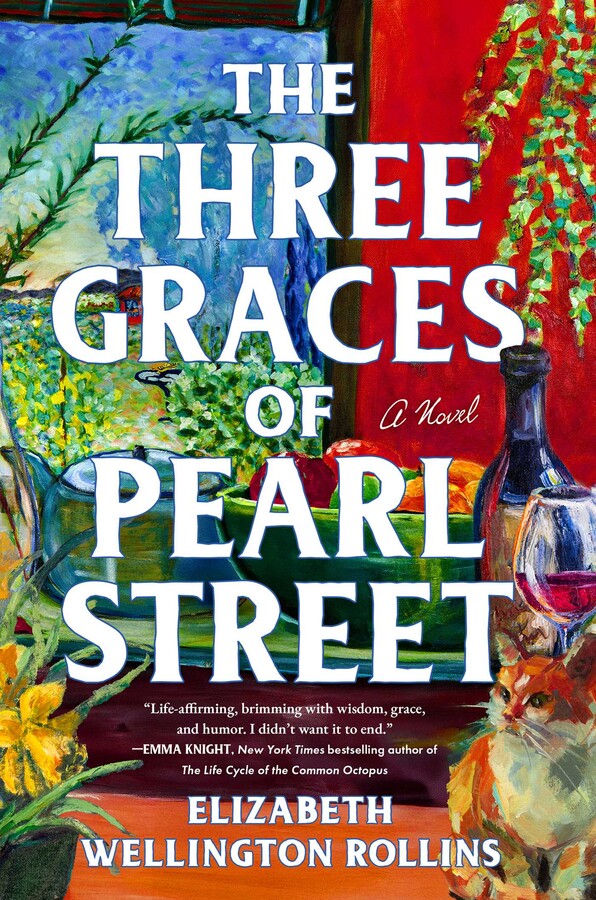
There are some books that seem to arrive at exactly the right moment. The Three Graces of Pearl Street is one of those books. It’s a warm, hopeful novel about aging, friendship, and small acts of kindness that can transform a life.
Elizabeth Wellington Rollins was kind enough to send me an ARC of this novel. I have posted a review of it, which you can find here.
At the center of the novel is Graziella, a former nun whose devotion to serving others — often through food, generosity, and the simple act of showing up — gives the story much of its heart. Her relationship with her granddaughter, Ella, adds another layer to the novel, reminding us that the people we love most can sometimes be the very people who frustrate us most.
I was especially interested in the novel’s treatment of later life. Rather than presenting aging as a period of decline, Rollins allows her older characters to remain complicated, funny, stubborn, faithful, loving, and very much alive.
Her answers below offer a glimpse into the personal experiences and ideas that shaped the novel, as well as what she hopes readers will carry with them after the final page.
The Interview
Q: The Three Graces of Pearl Street explores aging with remarkable warmth and hope. What inspired you to write a novel that celebrates later life rather than treating it as a period of decline?
A: I’ve always found warmth and hope in my relationships with older generations, and so this was less of a conscious choice and more of a default setting. I adored every senior in my family, and I soaked up my time with each of them like a sponge.
I’ve also always sought out relationships with seniors in formal and informal ways. When I was living in Boston in my 20s, I was lucky enough to have a landlord who was in her 90s who was also my downstairs neighbor. We developed a regular rapport in our little brownstone, and she was bursting with life, verve, and humor. She made my world and my life so much bigger.
I feel that way about seniors on the page, too. Ever since I read A Man Named Ove, which is published by the same imprint as The Three Graces of Pearl Street, I knew I would write an older character one day. I’m so delighted to see Graziella make her way into the world through this novel.Graziella’s commitment to serving others is one of the novel’s defining qualities. Was there a real person—or several people—who inspired her character?
Q: Graziella is her own fictional character, but the seedpoint for her service has deep roots in my own family tree and some lovely people I’ve met along the way.
A: I anchored her in the Italian-American culture of my maternal lineage, which inspired her primary mode of service: feeding people. I was always taught that service should be humble and anonymous or it doesn’t count, and Graziella definitely reflects that nuance, as well.
Q: Faith and conscience play important roles in the story. How did you approach writing about religious conviction while allowing your characters to wrestle honestly with disagreement and moral complexity?
A: I felt my way through this rather than approach the novel with a particular point of view. I knew that Graziella, a former nun who brought those values into her life in the neighborhood, would be someone who broke some rules to uphold others. There’s a line that Ella, her granddaughter, says, “She’s the most devout person I know and the least compliant.” And I also knew that the other two protagonists would have their own relationships with their faith, which changed as they changed.
My view is that faith is a dance that no one is going to live out in the exact same way because every person is unique. One of the joys of having three protagonists is showing a few contrasting variations of that, which I hope adds to the nuance of the narrative.
Q: The relationship between Graziella and her granddaughter, Ella, feels especially authentic. Were there particular family experiences or observations that helped shape their dynamic?
A: I think there’s this relatable paradox that you can admire someone wholeheartedly the way Ella admires her grandmother Graziella and still be completely frustrated by them. Ella and Graziella are so alike that they struggle to fit into each other’s lives in a consistent way. I think it’s relatable, and I wanted to walk people through the evolution of the relationship from that starting point.
Q: One of the novel’s central ideas is that ordinary acts of kindness can transform lives. Is this a philosophy that has guided your own life, or did it emerge as you were writing the novel?
A: I’ve always valued kindness, and I was so grateful to pull that thread into the novel. The older I get, the more I appreciate the difference between kindness and niceties, too. Those two concepts often overlap, but they are not the same thing. Graziella’s character and, quite frankly, the generosity and decency of New Yorkers, often reflects that subtlety.
Q: Many readers, myself included, found the novel comforting when thinking about grief, aging, and mortality. What do you hope readers carry with them after turning the final page?
A: I’ve heard from early readers that the novel feels like home. That feedback meant the world to me because that’s what I set out to do while writing it. In an ideal world, home is a heartening place to be. It fills us up before we need to go into the world and face down challenges and uncertainties. The novel is an emotional journey, but I hope it leaves people feeling renewed and supported, the way I would wish that every person feels in their own homes.
Q: Finally, just for fun: if you could sit down over coffee with Graziella for an afternoon, what question would you ask her—and what do you think her answer might be?
A: I would, in earnest, ask Graziella how she would suggest that I manage this new career as a working mom. Betting on my creative work as a full-time novelist was a huge leap for me, and the role defies some of the norms of a 9-5 job.
I would love to take marching orders from her about how to make it work. Not only the big picture, but the specificities: Should I freeze chicken cutlets before I leave town for every book event?
Her answer would probably be harsh but effective: “You’re stuck in that head of yours like a mouse on a wheel—the plague of your generation! Trust your instincts or you’ll suffer until the end of time for no reason. You know better or you wouldn’t have asked.” I imagine her waving around a wooden spoon and raising her voice while she says it.
A Final Thought
The Three Graces of Pearl Street promotes a specific idea: the truth that a meaningful life is not necessarily built out of grand gestures.
Sometimes, meaning is found in sharing meals with other people. It is nourished by friendships sustained over decades. Its mettle is tested in the arguments we have with people we love.
Most of all, meaning is found in the decision to show up for someone when they need us.
Home is not simply a place we inhabit. At its best, it is something we create for one another. And if Graziella really does have a wooden spoon in hand, I suspect she would agree.
☕ Enjoyed this conversation?
If you’d like to support more interviews like this one, you can buy me a coffee. It helps me keep making space for thoughtful conversations with writers and bringing them to the Tearoom.
Thank you for being here.


Leave a comment