
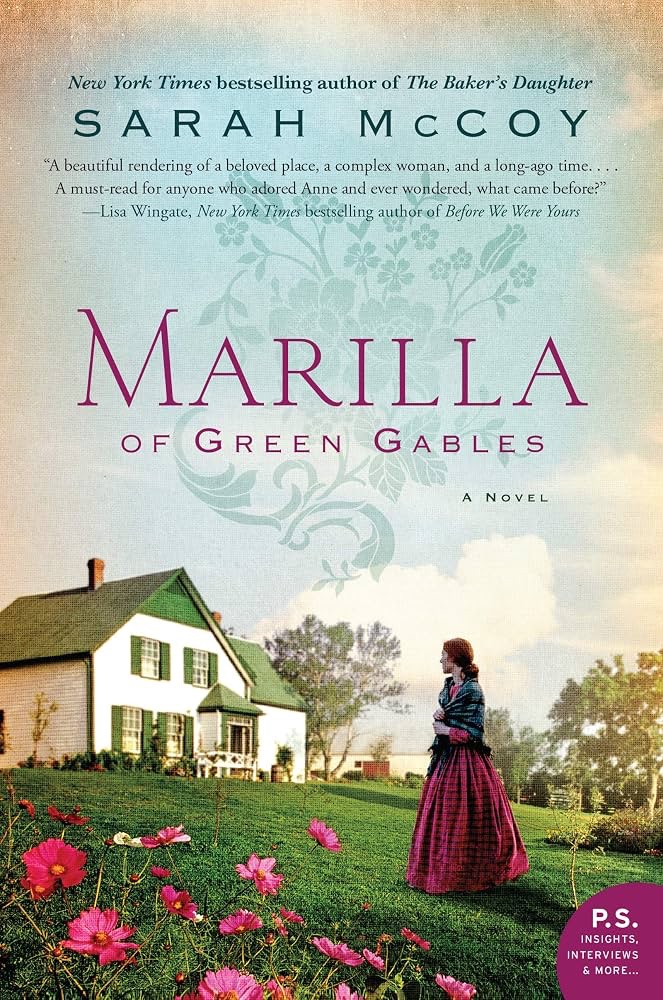
I believe that Marilla Cuthbert is one of the best-written characters in the literary canon, and also the most mysterious. So little detail is offered about her that she can easily be misunderstood or judged as harsh.
For example, in Anne of Green Gables, Marilla isn’t as welcoming to Anne’s presence in her home as Matthew. Through the eyes of young Anne Shirley, who has been swept by train from one crisis to another, Marilla appears to be an unloving and cantankerous woman.
However, readers who look closely at L.M. Montgomery’s original novel can immediately tell that there is more to Marilla Cuthbert. Today, creative license gives modern authors the freedom to try to fill in the blanks, allowing us to imagine backstories for characters like Marilla and, in doing so, enrich the reading experience.
One of the books I believe does this best is Marilla of Green Gables by Sarah McCoy. In this lovingly written tribute to Montgomery’s Anne of Green Gables series, McCoy gives us a plausible backstory for a character who is, in truth, far more profound than she initially appears.
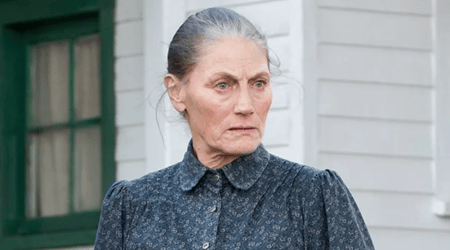
Understanding Young Marilla Cuthbert
As readers of L.M. Montgomery’s traditional series, we only know Marilla Cuthbert as she was in later life. We recall her fondly as a woman who, by nature, cannot abide idleness. In Marilla of Green Gables, Sarah McCoy describes Marilla’s childhood and gives us an entirely different perspective.
The pages that cover Marilla’s childhood reveal a girl who is not so different from the Anne Shirley we know:
Sometimes, as sinful as she knew it was, Marilla wanted to idle the day away however she pleased. When she could steal time, she’d take to the balsam woods with her Godey’s magazine leaflets and follow the brook until it cascaded to a little pool split in half by a maple growing right up through the center. She’d sit there on her island with the water bubbling around and read until the sun slanted thinly through the trees.
This passage establishes young Marilla as a child who was really not so different from Anne Shirley, even if Marilla would never admit it to Anne when she was raising her.
As children, Marilla and Anne both loved Green Gables and the many natural wonders surrounding it that made the place so special. They were both devoted to reading, though Anne was more inclined to let her imagination run away with her, depending on what she was reading.
In terms of writing style, McCoy stays true to Montgomery’s technique of using the wonders of the outdoors to establish the mood of a story. Marilla does not dramatically rechristen natural landmarks with names such as Lake of Shining Waters, but in her own way, she is able to befriend the trees, learning every nook and cranny of the land.
In Marilla of Green Gables, McCoy offers us a means by which to understand Marilla Cuthbert.
Reader, recall that this novel is not canon; it ought not to be read as part of the Montgomery set. But I admire novels like this—the loving projects of souls who loved a classic novel so much that they needed more of it, and then went on to write it.
Anne and Marilla Aren’t So Different
One of the pleasures of Sarah McCoy’s Marilla of Green Gables is seeing the connection between young Marilla and the girl Anne Shirley will eventually become.
Anne is famous for her imagination, her love of books, and her tendency to find beauty in the natural world around her. Marilla is more restrained, but McCoy shows us that the younger Marilla possessed many of these same qualities.
The difference between them is not that one girl loves beauty and the other does not. It is that Marilla has learned to contain the imaginative child she once was.
That makes her eventual relationship with Anne even more interesting. In some ways, Marilla is raising a younger version of the girl she might once have been.
Marilla Cuthbert and Motherhood
My previous post about the novel Hello Baby raised questions about motherhood and the desire to start a family. Marilla, in this novel, does not have the great desire for children that her friend Rachel White (later Lynde) does.
Page 219 explores this from Marilla’s viewpoint:
Marilla liked children, but motherhood seemed outside her realm of possibility… the tariff for motherhood was too great when there was already so much depending on her.
I do not feel like enough classic novels include the viewpoints of women who, like me, do not live only with dreams of motherhood. It’s not that Marilla—or I—dislike children or the idea of them. But there are so many women who want to be known for other things. They wish to be remembered for passions they already have, rather than the children that might come along one day—if a good man turns up.
In fact, right after the quote about the “tariff for motherhood,” Marilla’s reverie continues, taking a turn in the old-fashioned manner of thinking:
Besides, to bear a child, one must first have a husband… on that account, Marilla could not deny the lingering weight of regret.
We see that Sarah McCoy’s Marilla is not opposed to the idea of marriage. She is human, and—as I pointed out recently—most humans are fascinated by the magic and warmth of a love story.
Indeed, Marilla is in love with one man. Due to a loss of temper, she has a falling out with him. She is the ultimate romantic in that she will love no one else. She will not settle for lukewarm love or an obligatory marriage simply for the possibility of having children.
The irony is this: though Marilla does not yet know it, a child will one day come along—just not in the way she has always expected.
Matthew Cuthbert and Marilla’s Bond
Matthew Cuthbert appears for a very short time in Montgomery’s novels, yet everything he does and says seems more memorable than that of many other characters. He does not stay in Anne’s story for very long, yet manages to burrow into the hearts of readers who meet him.
In Chapter 2 of Anne of Green Gables, he is introduced as a man who can only be lured out for important quests, such as retrieving an orphan from a train station. Montgomery gives us an endearing description of this man. His presence is so fleeting that he is almost a wild creature from the woods of Avonlea:
…he was an odd-looking personage, with an ungainly figure and long iron-gray hair that touched his stooping shoulders, and a full, soft brown beard which he had worn ever since he was twenty. In fact, he had looked at twenty very much as he looked at sixty, lacking a little of the grayness.
We are told that Matthew is reclusive: he “dreaded all women except Marilla and Mrs. Rachel; he had an uncomfortable feeling that the mysterious creatures were secretly laughing at him.”
This description has always stood out to me, as it says so much about Matthew Cuthbert and yet so tantalizingly little.
Sarah McCoy makes a beautiful effort to fill in the blanks behind this sentence. She paints us a picture of Matthew Cuthbert’s one and only true love, a girl named Johanna who led him to believe that he had a chance with her—then one day decided she did not want what Matthew could offer:
“I’m not your sweetheart or anything else, Matthew Cuthbert. I’d rather die than be a farmer’s wife.”
And we then see the strength of Matthew and Marilla’s bond:
Saying nothing, Marilla put a hand on his back. He didn’t turn, and she didn’t face him…. She didn’t see him cry, but she felt it, trembling through his bones and into hers, like a tuning fork, until her own cheeks were wet with tears.
There are not many sibling relationships in literature that hit as powerfully as that of the Cuthberts. They have grown up together in their family home, seen the years go by side by side, and, in spite of their differing personalities, need one another.
They make choices together, as we see in the ninth chapter of Anne of Green Gables:
“Well, now, she’s a real nice little thing, Marilla. It’s kind of a pity to send her back when she’s so set on staying here.”
“Matthew Cuthbert, you don’t mean to say you think we ought to keep her!”… “What good would she be to us?”
“We might be some good to her,” said Matthew suddenly and unexpectedly.
McCoy’s most powerful Matthew quote is the following:
“I have a voice just as much as you do. It’s a choice we make every minute. What truths are important enough to say aloud and what ones are important just to know…. You can change your mind anytime you want, but you can’t take words back. Not ever.”
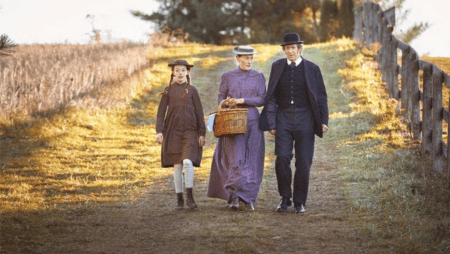
Marilla Cuthbert Was Already Whole
Given the time in which she was born, Marilla Cuthbert’s life does not unfold according to the obvious script.
She does not marry young to have children of her own. She does not spend her life dreaming about the family she might someday have. Instead, she builds a life with what she has: her home, her brother, her work.
Eventually, all of this is uprooted with the arrival of a red-haired girl who has a lot to teach her. Make no mistake, though: Anne Shirley changes Marilla, but does not complete her. Marilla was already a whole woman before Anne came along.
There is something deeply comforting about a character whose life is not presented as a waiting room for the life she is supposed to have. Marilla has desires, regrets, disappointments, and loves, but she is never merely an unfinished version of herself.
She becomes a woman through the life she actually lives.
Sarah McCoy’s Marilla of Green Gables gives us the pleasure of imagining all the years L.M. Montgomery left unwritten, but it also reminds me why those unwritten spaces are so compelling. The lives of women like Marilla cannot always be reduced to what they expected to become.
Sometimes a fresh start is something we choose. Sometimes it is thrust upon us. And sometimes it arrives quietly, disguised as a person we never expected to love.
Marilla did not know what her life would become. Perhaps that is the most beautiful thing about her. She did not have to know.
She simply kept living it.
And eventually, Anne arrived.
☕ Enjoying the Tearoom? Buy me a coffee. Your support helps me keep reading, writing, and making a little space on the internet for thoughtful conversations about books, women, art, and the stories we carry with us.


Leave a Reply